
Scuba divers spend years learning to manage the gas on their back. Freedivers manage the gas in their lungs, and the margin for error is thinner. The upside is a quiet, intimate way of meeting the ocean. The catch is that the biggest risk, a blackout, can arrive with almost no warning. This guide covers how freediving safety actually works, what a proper course teaches, and how to build depth without gambling with it.
- Golden rule: never freedive alone, in a pool or the sea, at any depth.
- Main hazard: low oxygen causing loss of consciousness, often near the surface at the end of a dive.
- Training: entry courses run roughly two to three days (PADI Freediver and AIDA 2 are typical), with confined-water and open-water sessions.
- Rest: long surface intervals, commonly two to three times the dive time, are standard advice.
- Progress: add depth in small steps and keep working dives well inside your limit.
How freediving differs from scuba and snorkelling
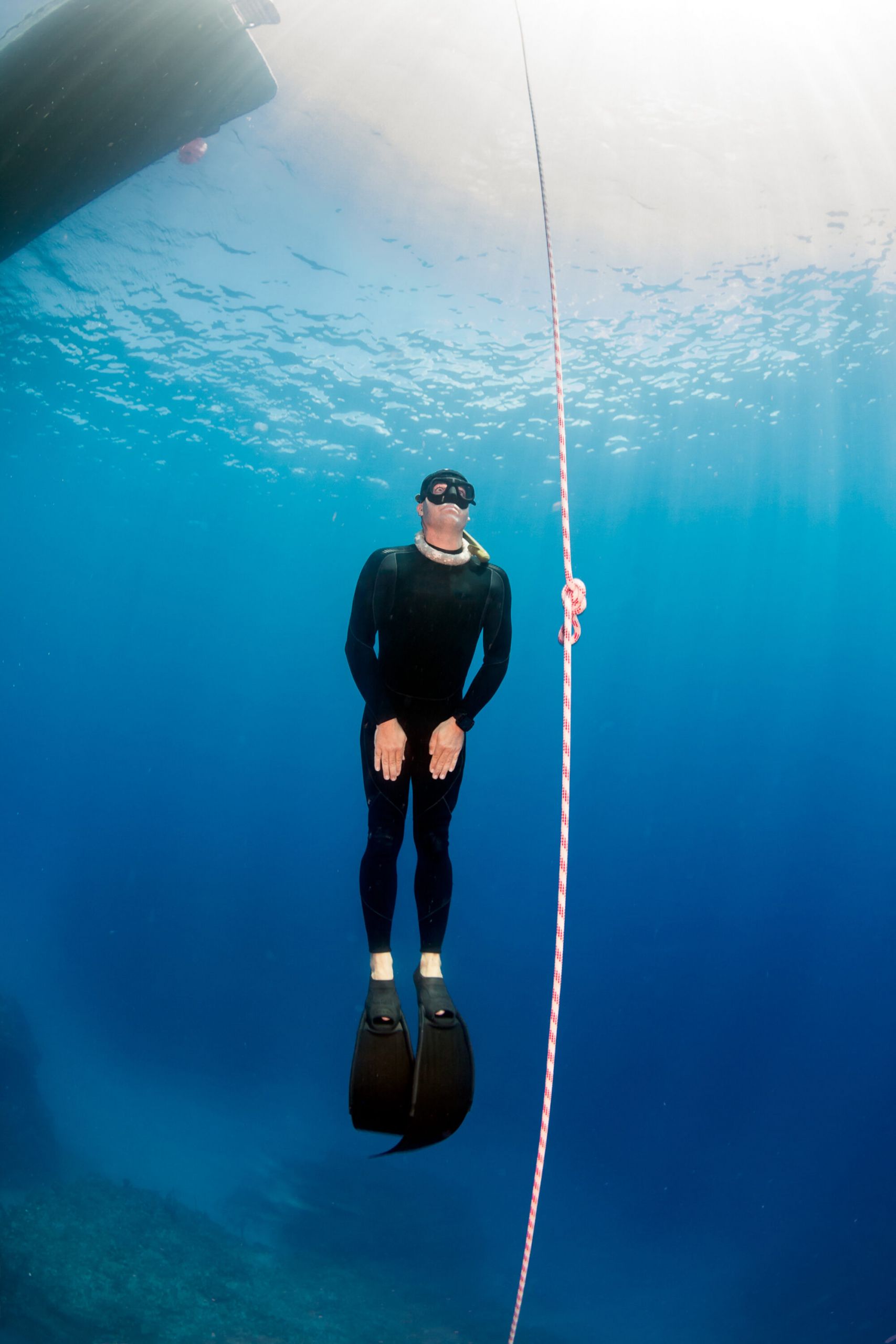
Snorkellers float and peek; freedivers hold a breath and go down, using a streamlined body, long fins or bare feet, and relaxed technique. Compared with scuba there is no regulator, no gauge, and no buddy checking your gas. Everything that normally keeps you safe has to be replaced by preparation and by the people around you. If you are still comparing the activities, our piece on the difference between scuba, snorkelling, skin diving and freediving is a good starting point, and Training Fundamentals: Freediving gives an older overview of the skills.
Why blackouts happen, and why they are sneaky
The urge to breathe is driven mainly by rising carbon dioxide, not by falling oxygen. That is the root of the problem. Divers Alert Network (DAN) explains in its freediving safety article that oxygen can drop low enough to cause unconsciousness underwater without any warning, and that unconsciousness can lead to drowning if nobody rescues the diver. Many blackouts happen on the way up or just after surfacing, because the pressure drop during ascent lowers the oxygen level in the lungs further.
DAN’s Alert Diver coverage of shallow-water blackout adds that incidents are most often linked to divers pushing limits, being overexerted, overweighted or unsupervised, and that a diver who has already had one low-oxygen event is at higher risk of another. Blackouts can happen in any body of water, but they are most dangerous when the diver is alone.
Hyperventilation: the habit to drop immediately
Breathing fast or deeply to “load up” lowers carbon dioxide, which switches off the urge to breathe while oxygen keeps falling. DAN defines hyperventilation as any pattern that lowers carbon dioxide, including long exhalations and extra-large breaths, and notes it can be accidental. A European Alert Diver rules list states that only six or seven forced breaths can have this effect, and that tingling in the hands or face is a cue to stop and wait before diving. Use calm, normal breathing and one comfortable final inhale.
The buddy system, in detail
Every reputable source puts the buddy at the centre of freediving safety. USA Freediving calls never diving alone the golden rule. What matters is that the buddy is trained, attentive and close.
- Brief before you dive. Agree depths, dive times, signals and what each person will do in an emergency. DAN recommends covering risks, planned dives, breath control, rescue and resuscitation.
- Assign roles for each dive. One person dives, the other watches. DeeperBlue’s training-safety piece suggests treating your safety dive as seriously as your own and not refusing safety to a diver beyond warm-up depth.
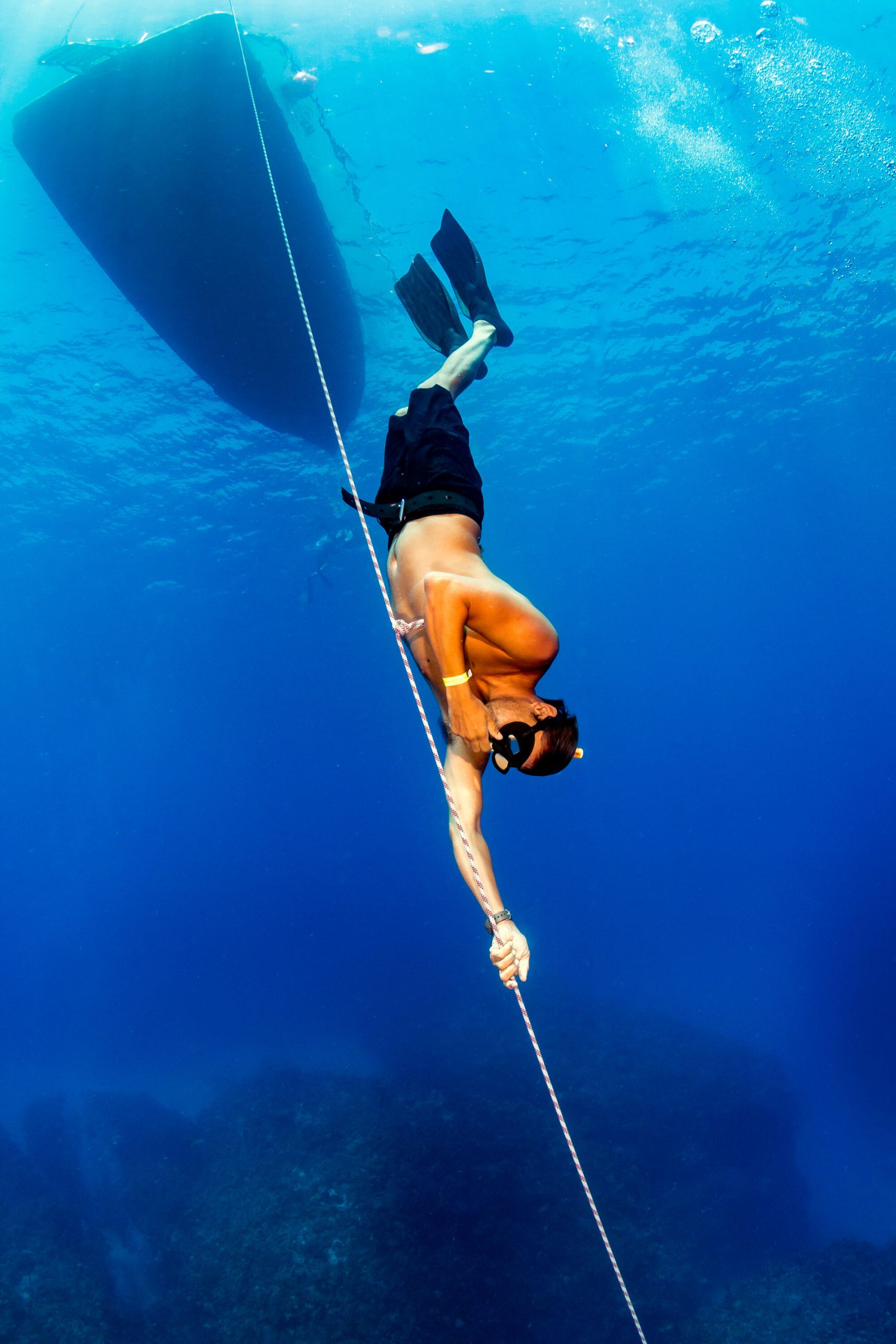
- Watch from the surface and stay close. USA Freediving advises never being out of arm’s reach of the diver once they surface.
- Learn your buddy’s normal. Changes in technique, tightening or trembling muscles, blue lips, or a large exhale of bubbles are warning signs DAN lists.
- Know your own limits as a safety diver. If someone wants safety at a depth you cannot comfortably reach, say so.
What the surface protocol looks like
The end of the dive is the riskiest moment, so freedivers follow a set routine. Courses teach their own versions, so treat the following as the shape of it and learn the exact steps from your instructor:
- Surface, remove the mask or nose clip, give the agreed “I’m OK” signal and speak clearly.
- Use recovery breathing (short, controlled breaths, sometimes with a “hook” at the top of the inhale) to bring oxygen back up quickly.
- Your buddy keeps watching until you are visibly recovered.
A 2019 study in Frontiers in Physiology tested hook breathing in 22 freedivers after 30 m (98 ft) dives. In the five divers who recovered oxygen saturation slowly, hook breathing brought it back to 95% in about 60 seconds versus about 120 seconds with normal breathing; the fast recoverers showed no difference. It is a small study, but it supports the idea that how you breathe after surfacing is a skill worth practising.
If a buddy blacks out: the four Rs
DAN’s Alert Diver article frames rescue as four steps: recognise the signs early, retrieve the diver quickly and protect the airway, revive using tap, blow and talk, and recover, which means staying out of the water for at least 24 hours after any blackout or loss of motor control. Reading about it is not enough. Rescue is a hands-on skill, so practise it in a course with an instructor.
Courses: what you get and how they compare
Formal training is the single best safety investment. Agencies differ in detail, and school requirements can vary by country, so confirm specifics with your instructor.
| Course | Depth guide | Notes (from agency or school pages) |
|---|---|---|
| PADI Basic Freediver | To 6 m (20 ft) | Knowledge and confined water only; open from age 12. |
| PADI Freediver | 10 to 16 m (30 to 55 ft) | Minimum age 15; at least three water sessions, two in open water; 200 m swim (or 300 m with mask, fins and snorkel); medical form. |
| PADI Advanced Freediver | 16 to 24 m (55 to 80 ft) | Builds on the Freediver level. |
| SSI Freediver | To 20 m (65 ft) with a buddy | Online learning plus pool and open water; water-fitness evaluation including a swim and survival float. |
| AIDA 2 (Beginner) | Varies by school | One UK school describes three days and an age of 18 (16 with parental supervision). |
| AIDA 3 (Intermediate) | 24 m (79 ft) in open water | Includes rescue skills; schools list a 2:45 breath hold and 55 m fin swim as targets. |
Every medical form matters. PADI requires a medical history form, and a doctor’s sign-off if any listed condition applies. Do not skip that step to save a day.
A sensible first-year training plan
- Weeks 1 to 2: course. Complete an entry-level course covering breath-hold technique, static and dynamic apnea, free immersion, equalisation and buddy rescue.
- Weeks 3 to 8: pool and shallow water. Practise relaxation, streamlined finning and recovery breathing with a trained buddy. Keep warm-up dives shallow; the European rules list suggests limiting them to about 5 m (16 ft) and three or four dives.
- Months 3 to 6: gentle depth progress. Add depth in small steps. USA Freediving advises treating training gains as extra safety margin, not as a new working limit.
- Months 6 to 12: consolidate. Refresh rescue skills, take first aid and CPR, and consider the next course level.
Our older article on freediving and breath-hold training covers dry practice, and you can pair that with the guidance in equalising your ears, since forced equalisation is one of the most common ways beginners hurt themselves.
Gear: keep it simple
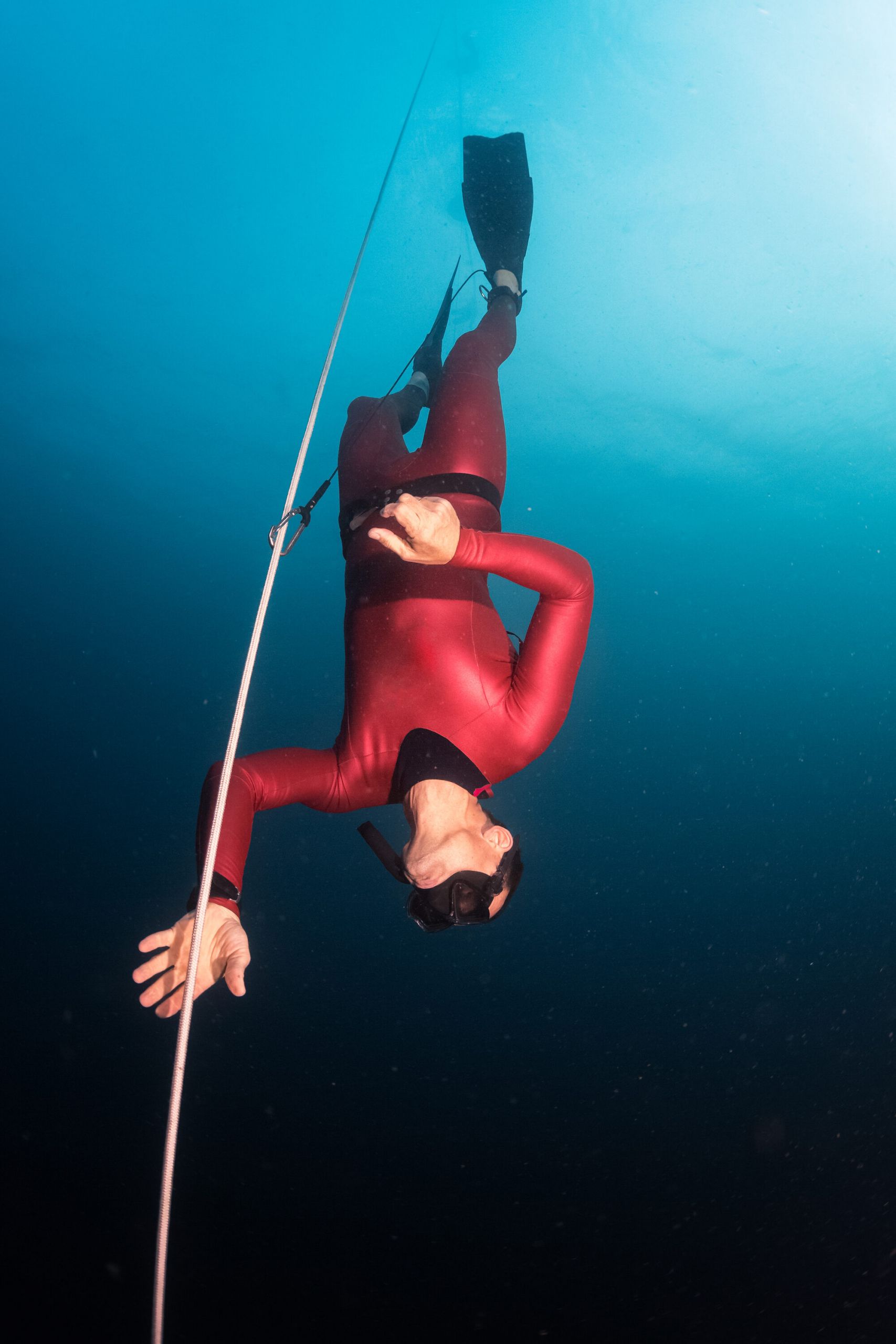
A low-volume mask, a snorkel for the surface only (take it out of your mouth when you dive), fins that suit your leg strength, and a wetsuit matched to the water temperature are enough to start. Weighting is critical: USA Freediving advises being positively buoyant at the surface, and the European rules suggest positive buoyancy through the last 10 m (33 ft) of the ascent. If you are weighted so heavily that you cannot float, you are asking a rescuer to do your work. See our introduction to freediving gear for the equipment basics. Wearing a lanyard, as DeeperBlue’s safety article recommends in poor visibility or current, ties you to the line and your safety.
Common mistakes and how to fix them
| Mistake | Fix |
|---|---|
| Hyperventilating to hold longer | Breathe calmly, take one full final breath, and train relaxation instead. |
| Diving with an untrained buddy | Pair with someone who has a freediving rescue course, and practise rescues together. |
| Short surface intervals | Rest for at least two to three times the dive time and use a timer. |
| Forcing equalisation | Turn around, dive another day. |
| Chasing personal bests | Keep most dives comfortably inside your limit. |
| Diving ill, tired or dehydrated | Skip the session; hydrate and don’t dive on an empty stomach or after a heavy meal. |
Freediving and scuba on the same trip
Many divers do both, but scheduling matters. PADI’s blog suggests waiting about 12 hours before scuba after a single freedive session and 18 hours after repetitive freediving, and avoiding flying for 18 to 24 hours after deep freedives, while noting data are limited and the figures are the author’s guidance rather than a published standard. Follow your agency’s current guidance and ask your instructor. For general scuba rules see our article on safety stops.
Frequently asked questions
Do I need to be a strong swimmer?
You need to be comfortable. PADI asks for a 200 m swim, or 300 m with mask, fins and snorkel, without stopping and with no time limit, plus a medical history check.
Is freediving more dangerous than scuba?
The risks are different, not simply larger or smaller. The dominant freediving risk is blackout, which is manageable with training, a trained buddy and conservative habits, according to DAN.
Can I practise holding my breath at home?
Only sitting or lying down in a safe spot, never in water, never while driving, and never alone in a bath or pool. Breath-hold practice in water without a trained buddy is where many incidents occur.
How deep will I go on a first course?
Agency guides range from about 10 to 16 m (30 to 55 ft) on PADI Freediver to a 20 m (65 ft) maximum for SSI Freediver. Your instructor will decide your depth on the day.
What if my buddy blacks out?
Follow the rescue you were taught: recognise, retrieve, revive and recover, and get medical help. This is why a rescue course matters.
Sources: DAN Alert Diver, Freediving Safety Awareness (2023); DAN Alert Diver, Shallow-Water Blackout (2023); PADI Freediver FAQ; PADI Blog; SSI Freediver; Freedivers UK, AIDA courses; USA Freediving safety; Alert Diver Europe, 15 basic rules; DeeperBlue, safety in training sessions; Fernandez et al., Frontiers in Physiology (2019). This article is general information, not medical advice.