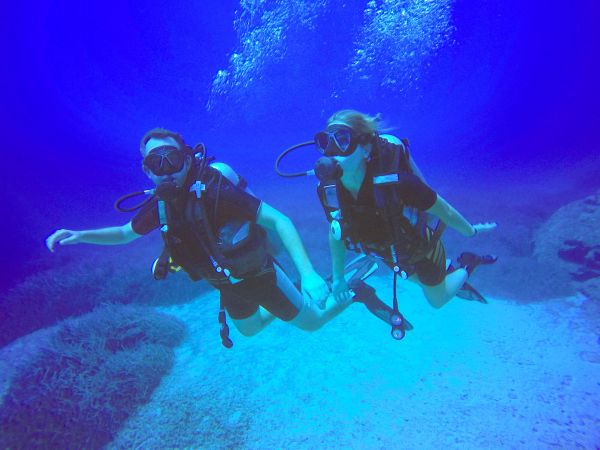

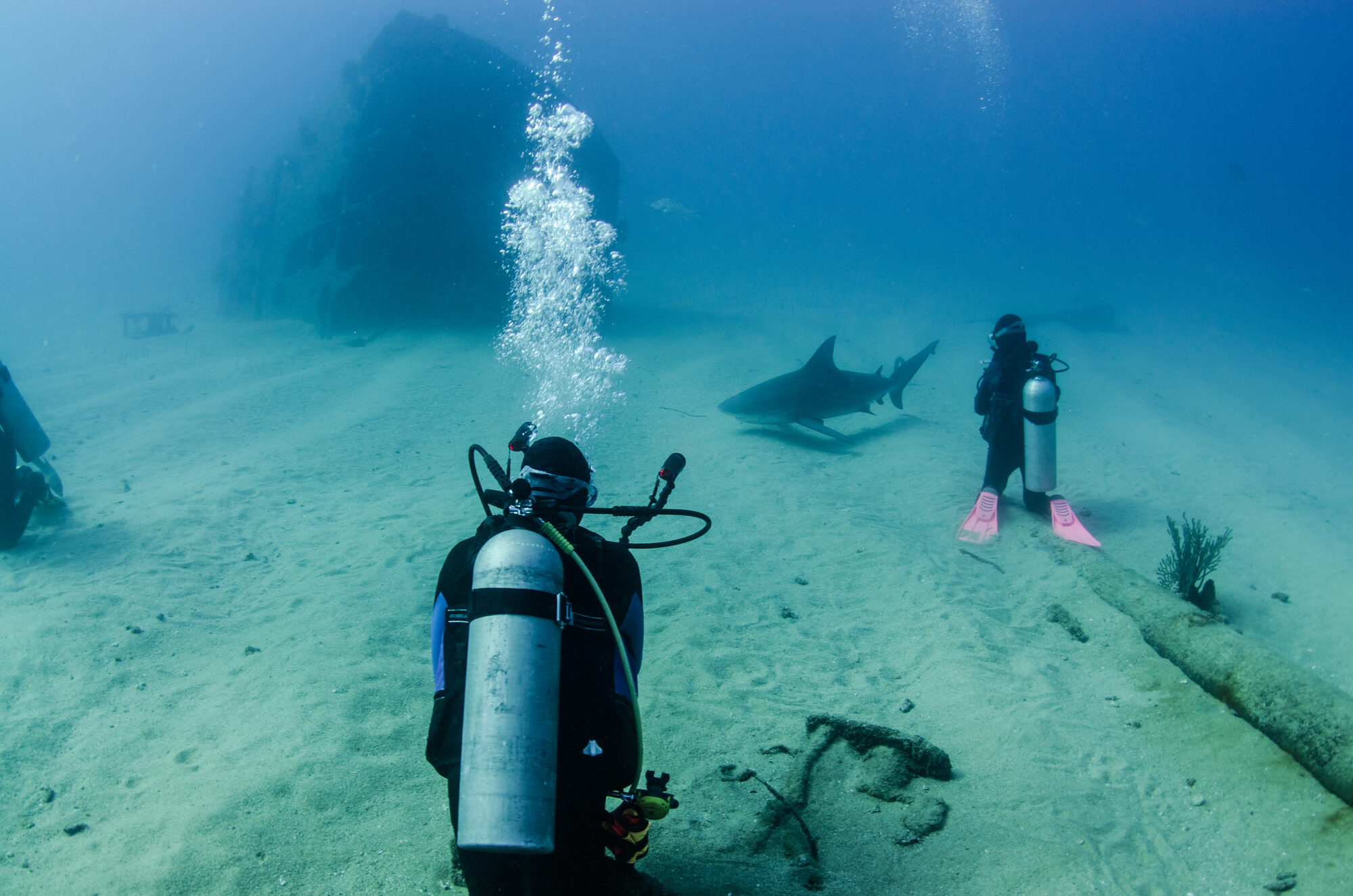
A shark dive can be the highlight of a diving life: calm, quiet and full of respect for an animal that has been misunderstood for generations. It can also be a muddle of crowded boats, rule-breaking and poor buoyancy. What separates the two is mostly preparation and manners, on the part of both the operator and you. Here is what to expect, how to behave, and how to pick a trip you can feel good about.
At a glance
- Formats range from open-water encounters with no bait, to feeding dives, to cage dives, and they raise different questions.
- Decide beforehand whether you are comfortable with dives where sharks are fed.
- Stay calm, move slowly, keep your distance (one source says at least 6 ft / 1.8 m) and never touch or chase.
- Good buoyancy matters more than any gadget.
- The International Shark Attack File recorded 65 unprovoked bites worldwide in 2025, and describes the total as extremely low.
The main kinds of shark dive
Scuba Diving magazine’s overview asks readers to settle a few questions before booking: which sharks you want to see, where, whether you prefer a cage or open water, whether you are comfortable with dives where sharks are fed, and whether you want to join citizen science. Those choices map to three broad formats.
| Format | What it involves | Main talking points |
|---|---|---|
| Open-water encounter | You dive a site where sharks are naturally found, with no bait used to attract them. | Sightings are never guaranteed; behaviour is most natural; patience required. |
| Baited or feeding dive | Bait or chum is used so sharks gather near the divers. | More reliable sightings, but the most debated format; practice varies widely. |
| Cage dive | Divers stay inside a cage, often with bait to draw sharks to it. | Accessible to less experienced divers; the Shark Trust calls it controversial. |
Night dives and sharks seen on a normal reef dive are further variations. Whatever the format, the Shark Angels diving guidelines recommend choosing species and timing to match your own experience and the location’s seasonal patterns.
What happens at a briefing
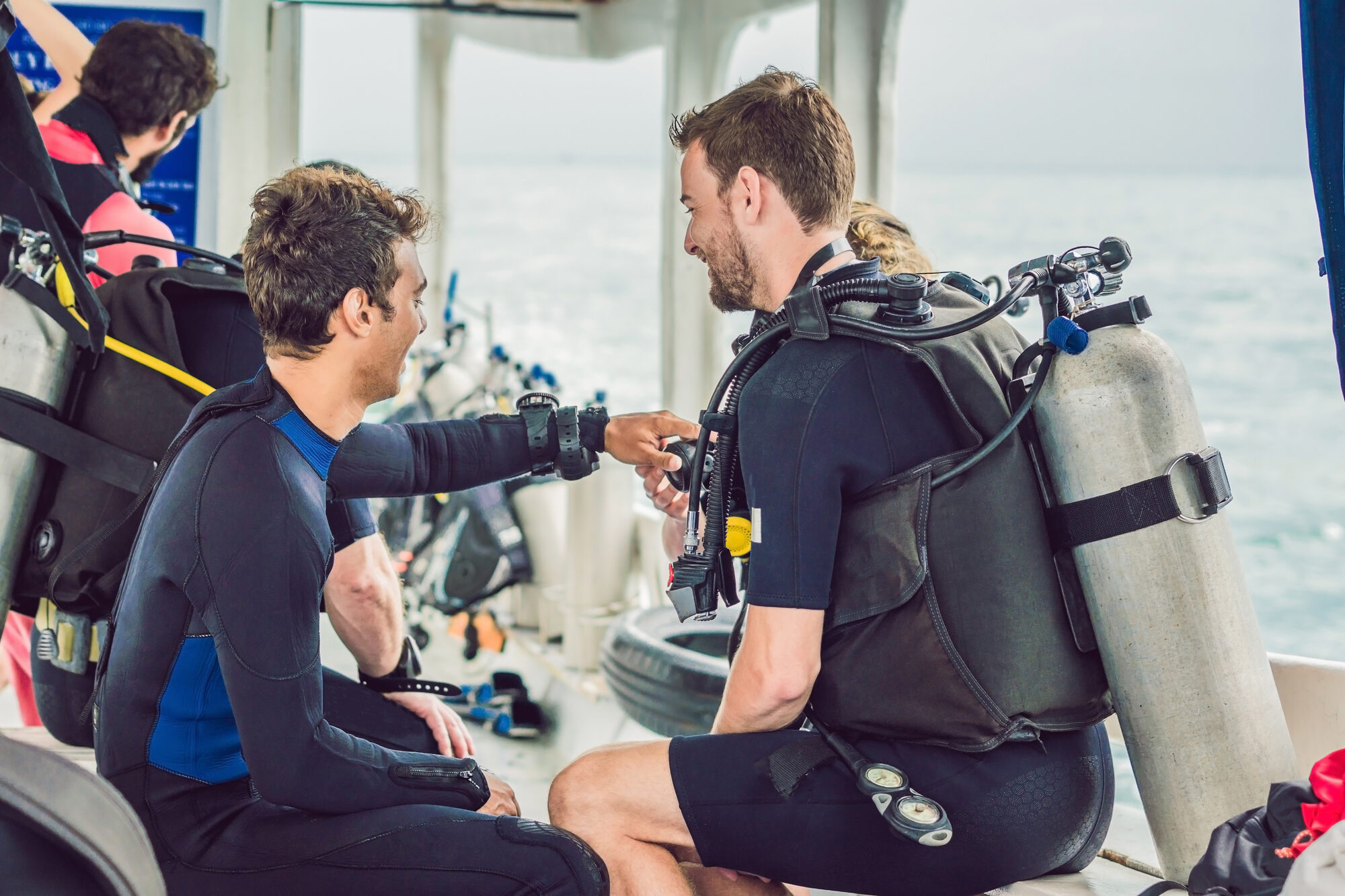
A thorough briefing is one of the best signs of a well-run trip. The Shark Angels guidelines say operators should make sure guests know the risks and how to respond in different situations. Expect your guide to explain the site, the format and the species expected, and to set out how divers should position and move. On a feeding dive, ask who handles the bait and how.
It is also your cue to speak up. The same guidelines say that if you are feeling uncomfortable or scared, it is best to sit the dive out, and they advise against diving in low visibility or between dusk and dawn unless you are experienced and have a very experienced guide. Nobody will think less of you for skipping a dive.
Behaviour rules that matter
The various codes and guides agree on a small set of principles:
- Stay calm and still. One liveaboard guide notes that sharks are sensitive to movement and sound, and that calm also saves gas. See our piece on improving air consumption.
- Keep your distance. The same guide puts it at least 6 ft (about 1.8 m).
- Do not touch, ride, chase or feed. Touching and feeding are described as dangerous and often illegal, and feeding may teach sharks to associate people with food.
- Move slowly. If a shark approaches closer than you like, do not sprint for the surface. The advice is to stay still and back away slowly.
- Follow your guide. Do not ask guides to change their baiting to get you closer or get a better shot.
- Respect local rules and warning signs.
Some sources add clothing and jewellery advice: Scuba Diving magazine suggests avoiding colours that could get you mistaken for a fish, and another guide warns against shiny jewellery. Treat these as sensible caution rather than proven science.
Rules are only as good as compliance. A 2018 review of shark-diving tourism, summarised by Faunalytics, reports a Philippines study with an 80% compliance rate with a no-touching rule, a different study with a 97% non-compliance rate with a minimum-distance rule, and a Mexico review where 23% of tourists touched sharks despite being told not to. Be the diver who follows the rules.

Buoyancy and positioning
Sharks tend to react to what you do, so your control of your own body is the first manners lesson. Scuba Diving magazine says that mastering your buoyancy will help you enjoy the encounter infinitely more, and it is easy to see why. A diver who drifts up and down, kicks the bottom or flails to correct a position is noisy, unpredictable and a nuisance to others. Practise before you go: work through our ten tips for better buoyancy, weight yourself properly, and trim out any dangling hoses so you can hover quietly.
Positioning is mainly about listening to the guide and respecting other divers. Hold the spot you are assigned, do not drift into someone else’s view, and do not swim after an animal to improve your angle. If sharks come to you, let them. If you are in a cage, keep hands and gear inside.
Photography etiquette
Cameras bring their own responsibilities. The Shark Angels guidance is to avoid bringing a camera until you are an experienced diver and comfortable with it, because your attention should stay on your surroundings. It adds that strobes and lights can attract sharks, which may bump or grab at a camera: do not fight them, and keep watching around you. Some operators provide a barrier such as a PVC pipe, which should never be used to hit or poke a shark.
A few extra courtesies follow naturally: do not crowd other divers for a shot, do not use your lens as an excuse to creep forward, and do not ask the crew to alter the bait presentation for a nicer picture.
The feeding-dive debate
Few topics divide divers like feeding. The Shark Trust calls it a controversial issue and sets out both sides without declaring a winner.
The case for: seeing sharks up close can inspire people to protect them, and shark tourism can make living sharks more economically valuable to communities than dead ones. In 2001, PADI argued that participants in responsibly organised feeding encounters become strong conservationists. That statement was written in response to a proposed Florida ban, so it is a dated position and the issue was described there as complex, with no clear-cut answers. Florida has since banned shark feeding, according to the Shark Trust.
The case against: feeding risks teaching sharks to associate people with food, and large carnivores should not be encouraged to do so. The Shark Trust’s cage-diving page notes that feeding may cause sharks to lose natural caution and might disrupt prey populations, but also states that there is little documented proof that sharks become dependent on handouts or more likely to attack, so a firm position is hard. A review by researchers Gallagher and Huveneers, again via Faunalytics, calls the ecological effects of shark-diving tourism a wide-open field of study and says the practice may be inherently problematic. Examples they cite include changes in habitat use by stingrays in New Zealand, other sharks frequenting a Bahamas site once it became a dive site, and schooling fish drawn in by stationary chum.
In practice the question is less “feeding or not” than “how”. The Shark Trust recommends feeding only with freestanding baits, poles or sticks, never by hand or mouth; avoiding indiscriminate chumming; minimising contact with sharks; using fish waste rather than fish taken from reefs; using permanent moorings; choosing sites away from busy swimming and fishing areas; and limiting the number of sites and how often feeds happen. It suggests asking operators whether they follow these principles.
Callout: it is your decision. Reasonable divers land in different places on feeding. PADI’s 2001 statement respected members’ right not to take part. You can pick an unbaited open-water trip, or a feeding trip run to strict principles. Either way, decide in advance rather than on the boat.
Realistic risk
The Florida Museum’s International Shark Attack File (ISAF) investigated 105 alleged interactions for 2025. It confirmed 65 unprovoked bites worldwide, in line with the 2020 to 2024 average of 61 a year, and 29 provoked bites. Twelve shark-related fatalities were recorded, nine of them unprovoked, close to the five-year average of 8 unprovoked fatalities. ISAF says unprovoked bites worldwide remain extremely low, while noting fatalities rose last year. The file’s definition matters for divers: provoked bites include those where a human starts the interaction, such as harassing or touching a shark, spearfishing or feeding. The page gives no separate figures for scuba divers, so it would be wrong to quote a “diver risk”. Among victims of unprovoked bites, 46% were swimming or wading, 32% surfing and 15% snorkelling or freediving.
The takeaway is not complacency but proportion: most risk on a shark dive comes from avoidable behaviour, such as touching, crowding or poor control, and from the setting.
How to choose an operator
Use the checklist below, drawn from Shark Trust, Shark Angels and Faunalytics guidance.
| Check | Why it matters |
|---|---|
| Experience with the species | Shark Angels advises an experienced, well-established, reputable operator who has worked with your target species. |
| Conservation, science and education | The Shark Trust says operators promoting these are more likely to offer respectful encounters. |
| Written code of conduct | Look for adherence to recognised codes, and for accreditation schemes where they exist. |
| Feeding method | Ask about bait handling, chum and frequency, using the Shark Trust principles. |
| Safety basics | An experienced shark guide and a first aid kit; a real briefing. |
| No crowding or chasing | Harassment distresses animals and can make them behave erratically. |
| Reviews and record | The Shark Trust recommends researching operators and reading online reviews. |
Remember too that Gallagher and Huveneers found rules are often broken, so ask how the operator enforces its own. A confident crew will welcome the question.
Frequently asked questions
Do I need to be an advanced diver?
Requirements vary by operator and format. Shark Angels recommends matching your skill to the dive; check with the operator about their minimum certification and experience.
Is a cage dive safer than open water?
The sources here do not compare the two on safety. They do note that cage diving and feeding dives each have issues, and that operators’ protocols vary and change often.
Should I bring a camera on my first shark dive?
Shark Angels suggests waiting until you are experienced and comfortable with your camera.
What if a shark comes close?
Stay calm, stay still, keep breathing and move away slowly rather than swimming off fast. Follow your guide’s instructions.
Sources: Florida Museum, ISAF 2025 shark attack report; Shark Trust, shark feeding dives; Shark Trust, cage diving; Shark Trust, boat tours; Faunalytics, Shark-Diving Tourism; PADI position on shark feeding, 2001; Shark Angels, Shark Diving Guidelines; Scuba Diving, Ultimate Shark Diving Guide; Liveaboard.com, Dos and Don’ts.