
Ear trouble is the most common injury in scuba diving, and the good news is that most of it is preventable. Equalising is a skill, and like any skill it gets easier with practice, patience and a few habits you can start before you ever get wet. This guide walks through what is happening in your ears, the techniques that work, and what to do when they do not.
At a glance
- The goal: open your Eustachian tubes so air can reach the middle ear as pressure rises.
- Little and often: equalise early and gently. Do not wait for discomfort.
- Techniques to learn: Valsalva (gently), Toynbee, Frenzel, voluntary tubal opening, and combinations.
- Pain means stop: ascend a few feet (about a metre), try again, and abort the dive if you cannot equalise.
- Never dive congested, and see a doctor for symptoms that follow a dive.
What is happening inside your ear
Your middle ear is an air-filled cavity sealed from the ear canal by the eardrum. DAN’s reference text explains that it connects to your throat through the Eustachian tube, and that this tube is normally closed. Pressure rises by about 0.5 psi per foot of seawater (0.1 kg/cm² per metre). Because gas shrinks as pressure increases (Boyle’s law), the eardrum bows inward as you descend, until air has to enter through the Eustachian tube to restore the space. Swallowing or yawning briefly opens the tubes.
The numbers explain why the first few feet matter most. DAN’s equalisation guide notes that a six-foot (1.8 m) descent from the surface compresses the middle-ear space by about 20 percent, which is enough to cause pain. Starting from 30 ft (9 m), the same 20 percent takes 12.5 ft (3.8 m). Relative pressure change is largest near the surface, so that is where you need to equalise most often.
On the way up, extra gas escapes through the tubes by itself once the pressure difference reaches roughly 15 to 80 cm of water (0.5 to 2.5 ft), according to the DAN reference text. That is why ascent equalising is usually passive, though some divers need a little help.
The techniques, one by one
DAN describes every method as simply a way to open the lower ends of your Eustachian tubes. Learn more than one, because a technique that fails for you on Monday may be the one that works on Tuesday.
- Valsalva: pinch your nostrils (or close them against the mask skirt) and blow gently through your nose. It is the one most of us learn first. DAN cautions that blowing hard can cause damage, and says not to hold pressure for more than five seconds. It also does not activate the muscles that open the tubes, so it can fail once the tubes are locked by a pressure difference.
- Toynbee: with your nostrils closed, swallow. DAN describes it as good for ascent.
- Frenzel: close your nostrils and the back of your throat, as if straining to lift a weight, then make a “K” sound. This raises the back of the tongue and compresses air against the tube openings. Scuba Diving magazine prefers it because it is gentler and easier to control, although DAN says many divers find it difficult until they have practised it repeatedly.
- Voluntary tubal opening: tense the soft palate and throat muscles while pushing your jaw forward and down, as if starting a yawn. It takes considerable practice. DAN’s reference text says it works for up to 30 percent of divers.
- Lowry: blow and swallow at once, combining Valsalva and Toynbee.
- Edmonds: jut your jaw forward, then use Valsalva or Frenzel.
DAN’s advice for learning them is practical: practise in front of a mirror, where you can watch your throat muscles work. Try each method on land in a quiet room, with and without your mask on, until you get a reliable click or pop in both ears.
Before you descend
Good equalising starts before the boat. Scuba Diving magazine suggests confirming that you hear or feel a pop in both ears when you swallow, stretch your jaw, or pinch and blow. It also suggests equalising gently every few minutes in the hours before the dive, chewing gum to prompt swallowing, and avoiding mucus-producing triggers such as milk, tobacco smoke and alcohol.
DAN’s reference text adds a useful in-water step: while neutrally buoyant, with no air in your BCD, gently inflate your ears to add a little air to the middle ear and sinuses before you drop.
Most importantly, do not dive with a cold or allergy symptoms. DAN’s advice is blunt: never dive with congestion, a head cold or allergy symptoms. The same goes for ears that crackle, pop or feel full after a previous dive.
How often to equalise
Sources agree on the principle, not the exact number. DAN’s equalisation guide says most authorities recommend equalising every two feet (0.6 m) of descent, which works out to roughly every two seconds at 60 ft (18 m) per minute. DAN Europe suggests about every 0.3 to 0.5 m. DAN’s Alert Diver magazine advises that after a failed attempt you ascend 2 to 3 ft (0.6 to 0.9 m) and then clear every 1 to 2 ft. The reference text suggests equalising gently every few feet for the first 10 to 15 ft (3 to 4.5 m).
The takeaway: equalise early, often and gently, especially in the first few metres. If you feel discomfort, DAN Europe says you probably waited too long. DAN’s guide also says to equalise again once you reach maximum depth, because even a small negative pressure held for several minutes can gradually cause barotrauma.
A slow, controlled descent is your friend. If you struggle with buoyancy at the start of the dive, our ten tips for better buoyancy control can help you settle before you drop.
Head-first or feet-first?
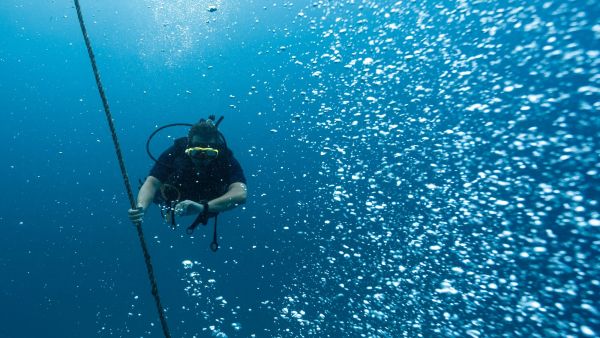
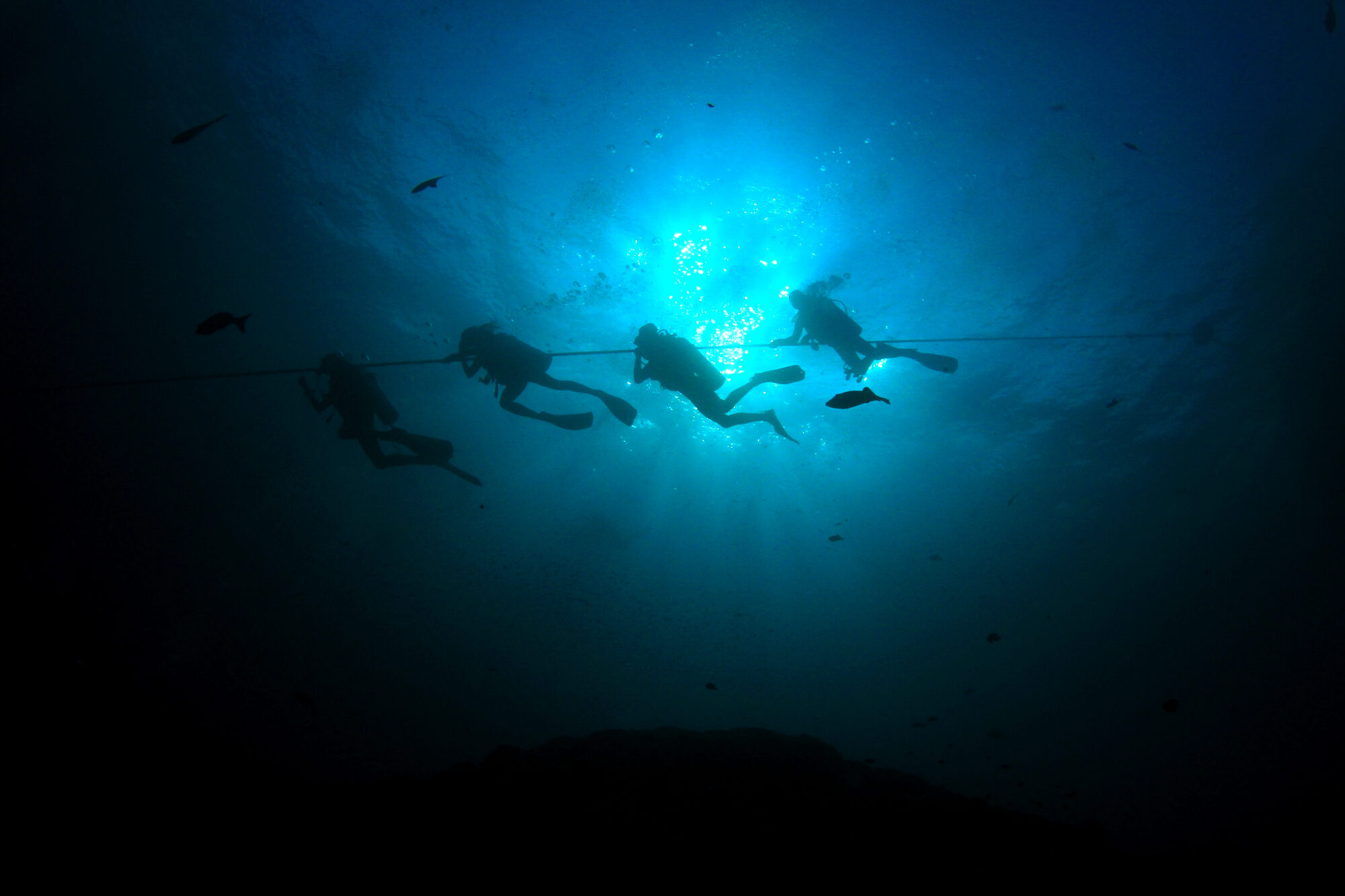
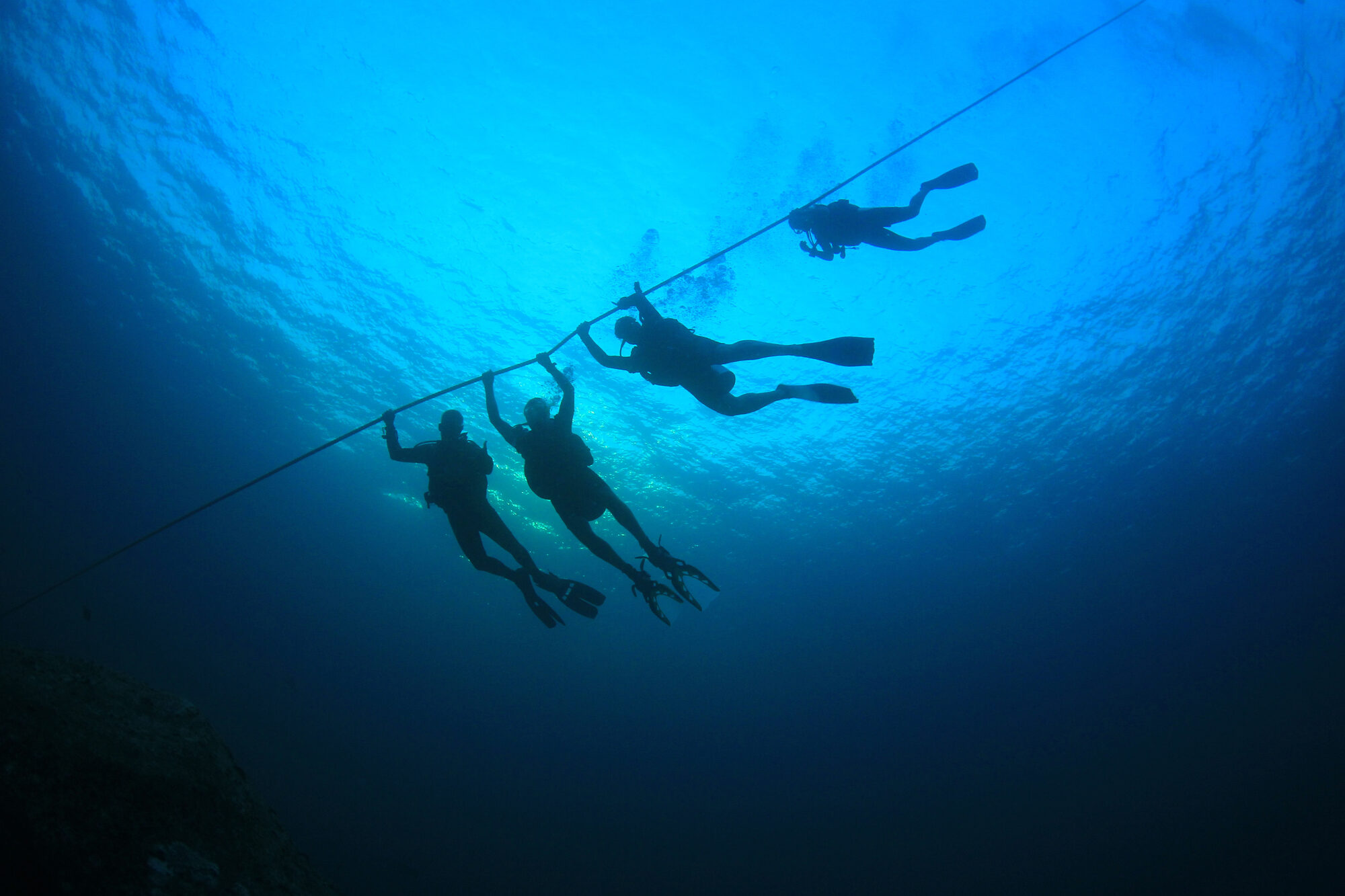
DAN’s reference text recommends descending feet first if possible, so that air moves upward into the Eustachian tube, and using a descent or anchor line to control speed. DAN Europe agrees and adds that tilting your head up can help open the tubes. Scuba Diving magazine cites studies suggesting that feet-up positions may need more force to equalise than feet-down, though many divers are not affected. It also notes that freedivers should not tilt their heads up, because it may contribute to blackout.
A line also gives you something to hold while you troubleshoot. As Scuba Diving puts it, a slow descent gives slow ears more time, and the line lets you stop quickly. If your ears are slow, make a feet-first descent on a line your default.
Common problems and what to do
| Problem | What it can mean | What to do |
|---|---|---|
| Fullness or pressure on descent | Tubes not opening yet | Stop descending, equalise gently, ascend a few feet if it does not clear |
| Sharp pain | Negative pressure in the middle ear | Ascend until pain stops, try again; do not force. DAN: pain is not acceptable |
| Only one ear clears | Uneven pressure; risk of vertigo if the gap grows | Stop, ascend slightly, work on the stubborn side; tilt it toward the surface |
| Pain or fullness on ascent | Reverse block | Pause or descend a little, equalise, then ascend as slowly as possible (DAN Europe) |
| Dizziness, vertigo, sudden hearing loss | Possible inner-ear injury | Abort, tell your buddy, and see a doctor |
Alternobaric vertigo is worth knowing about. DAN’s reference text says it can occur when the ears equalise unevenly and the difference reaches about 66 cm of water (roughly 2 ft). If you suddenly feel dizzy during a dive, stop and signal your buddy.
Do not force it
Blowing against a blocked nose raises pressure in the inner-ear fluid, and DAN warns it may rupture the round window, so do not blow hard. Forced air can also lock the tubes shut. Gentle and frequent works better and carries less risk than one massive effort.
When to stop and abort
The rule is simple and every source agrees. If you feel pain, stop descending and ascend a few feet until it eases. If your ears will not open, ascend a few feet to reduce the surrounding pressure and try again, but do not bounce up and down. If you still cannot equalise, abort the dive. DAN’s reference text says pain, vertigo or sudden hearing loss during a dive should mean an abort, and if symptoms persist you should not dive again and should consult a physician.
Tell your buddy or instructor. Scuba Diving makes the point that they cannot know unless you say so. Never keep descending with unequalised ears: the magazine warns this can cause middle-ear squeeze or eardrum rupture. DAN’s reference text puts rupture of the eardrum at about 5 psi (0.35 bar) of pressure difference for some divers and over 10 psi (0.75 bar) for most.
When to see a doctor
DAN’s page on middle-ear barotrauma says any suspected ear barotrauma should be evaluated, and that any doctor can help in the first instance. Common symptoms are stuffed ears, discomfort that turns to pain, and fluid or bleeding in the middle ear. A ruptured eardrum may relieve pain but can bring vertigo and hearing loss, plus a risk of infection.
Seek care promptly for worsening pain, fever or discharge (possible infection), and for vertigo or hearing loss (possible inner-ear injury). DAN Europe recommends seeing a physician, ideally an ENT specialist, after any symptoms during or after a dive, and suggests stopping diving for the day and probably the rest of the week. DAN also warns not to put drops in the ear canal if the eardrum may be ruptured.
Returning to diving is a medical decision. DAN says to wait until swelling has resolved and you can equalise adequately, ideally confirmed by an exam, and that a physician must judge that the injury has healed. A DAN case summary is a good lesson: a diver went back in while symptoms were still incompletely resolved and had a painful, difficult dive. DAN’s advice is to stay out of the water until symptoms resolve fully, not just until they improve. This article is general information, not personal medical advice, so talk to a doctor about your own ears and about any medication.
Practice plan
- Spend a week practising two or three techniques on land, in front of a mirror.
- Use the first descent of a trip as a skill check: descend slowly, feet first, on a line.
- Equalise every foot or two (about 0.3 to 0.6 m) for the first 10 to 15 ft (3 to 4.5 m).
- Log what worked. Plenty of diving beliefs do not survive scrutiny (see our top 10 diving myths), and for more tips see four tips on how to equalise your ears.
Frequently asked questions
Is it normal for my ears to hurt a little?
No. DAN’s reference text states that pain is not acceptable. Stop, ascend a few feet and try again.
Can I use a decongestant so I can dive with a cold?
DAN says never to dive with congestion. For anything medicinal, speak to a doctor, ideally one who knows diving. Do not self-medicate your way past a block.
Are earplugs a good idea?
No. DAN’s middle-ear barotrauma page says not to dive with earplugs, as they may cause external-ear barotrauma.
Which technique is best?
There is no single winner. Scuba Diving prefers Frenzel for its gentleness, while Valsalva is fine when done gently. Learn several.
How long does recovery from ear squeeze take?
DAN Europe’s Alert Diver article says usually a few days, rarely weeks, but a doctor should decide when you can dive again.
Sources:
DAN, 6 Methods to Equalize Your Ears;
DAN, Ears and Diving: Ears Equalization;
DAN, Middle-Ear Barotrauma;
DAN, Go Easy on the Ears;
Alert Diver, Ear Squeeze;
DAN Europe, Avoiding ear and sinus injuries;
Scuba Diving, Equalizing.