
A whale shark gliding out of the blue is one of those moments that rearranges your sense of scale: a spotted fish longer than a bus, moving with no hurry at all and taking no interest in you. Seeing one is a highlight of a diving life, but the animal is endangered, the best encounters depend on the right month, and how you behave in the water matters more than most people realise. Here is how to plan well and behave better.

At a glance
- Size: the largest reliably measured individual was about 18.8 m (61.7 ft); the species is the biggest fish alive.
- Diet: filter feeder, mostly plankton, fish eggs and small schooling animals.
- Lifespan: estimated at roughly 80 to 130 years, though figures vary by study.
- Status: Endangered on the IUCN Red List since 2016.
- Golden rule: keep at least 3 m (10 ft) from the body and 4 m (13 ft) from the tail, and never touch.
- Timing: almost every site is seasonal, so check the month before booking flights.
Meet the biggest fish in the sea
The whale shark (Rhincodon typus) is a shark, not a whale, and the title of world’s largest living fish is firmly its own. Length records need care. The largest reliably recorded animal was a female of about 18.8 m (61.7 ft) reported from the Arabian Sea in 2001, while Western Australian authorities give a maximum of around 20 m (66 ft). WWF describes animals up to about 60 ft (18 m) and roughly 11 tons.
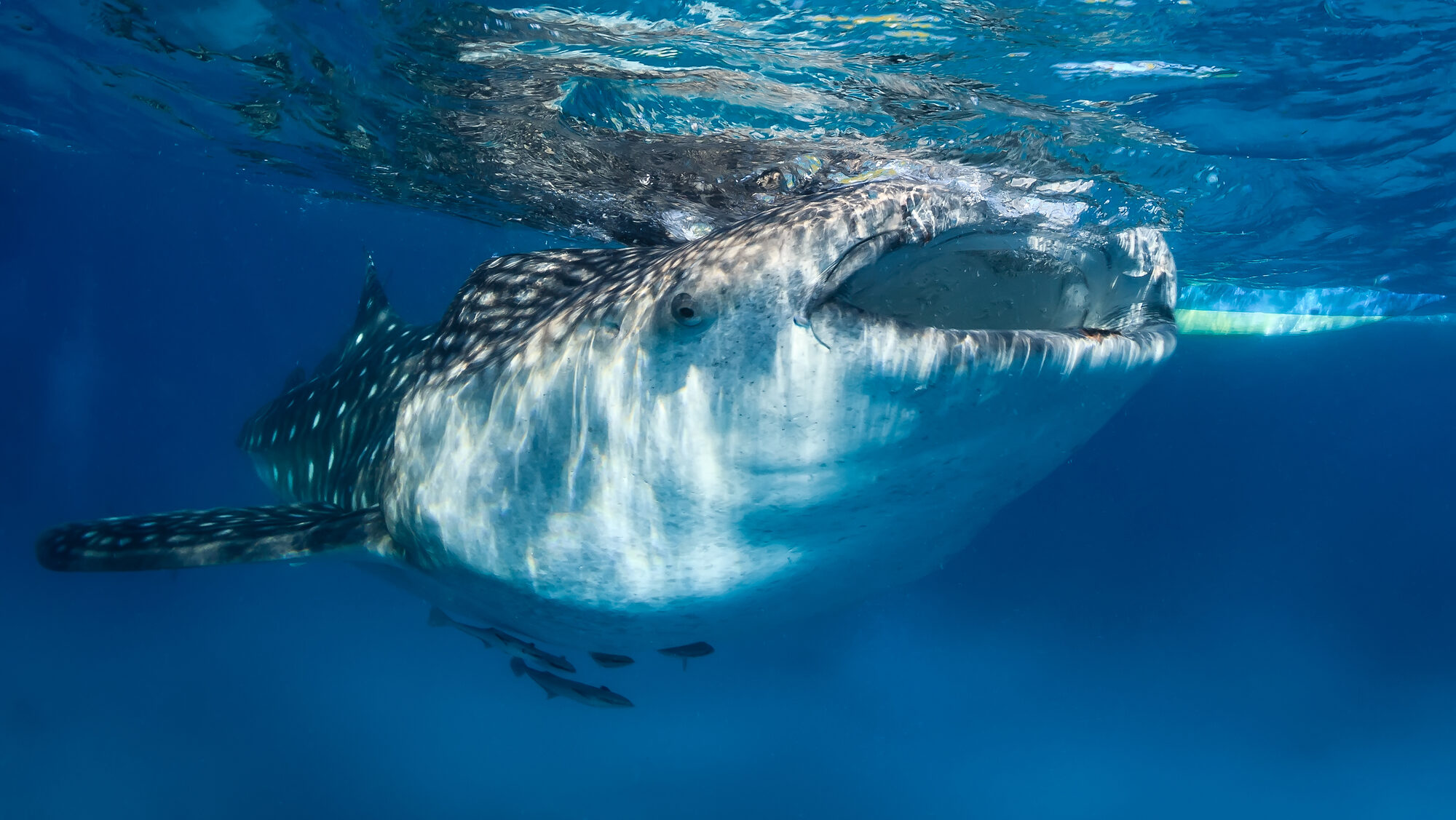
All that bulk runs on tiny food. Whale sharks are filter feeders that take in copepods, krill, jellyfish and other plankton, along with fish eggs and small schooling fish such as sardines and anchovies. At Ningaloo they are drawn by the coral mass spawning, and in Belize they have been reported timing their arrival to the springtime spawning of snappers, feeding on the floating eggs. Their huge mouths can be up to 1.5 m (5 ft) wide, yet they are harmless to people.
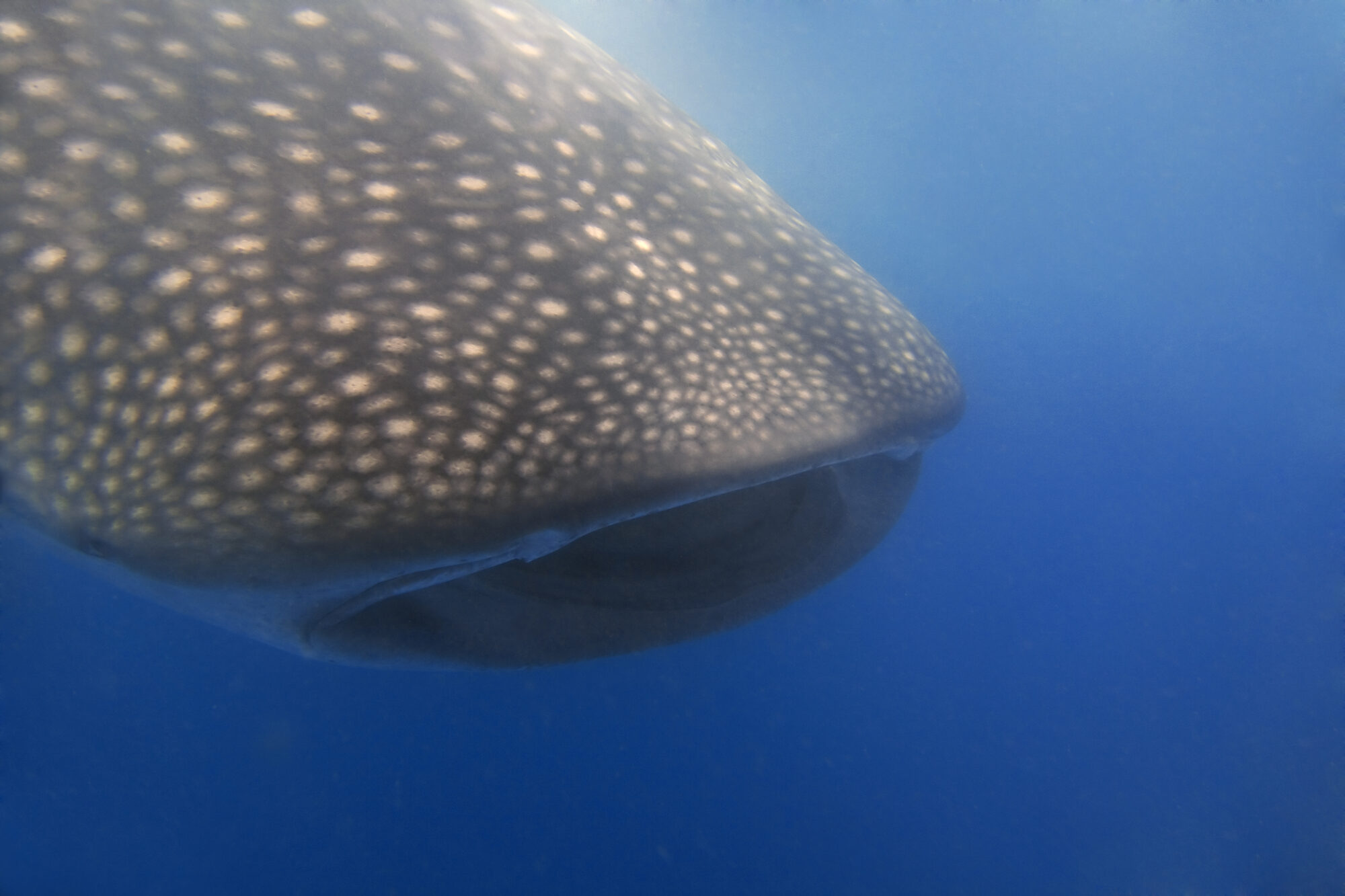
Growth is slow. Sources put sexual maturity at around 30 years for females, and lifespan estimates range widely: roughly 80 to 130 years from vertebral growth bands, and 70 to 180 years in a Western Australian summary. The honest answer is that nobody knows precisely. Their spot pattern, however, is unique to each animal, which is the key to how we study them.
Conservation status: why your behaviour counts
In July 2016 the IUCN moved the whale shark from Vulnerable to Endangered, citing a population decline of more than 50 per cent over about three generations, or roughly 75 years. The main drivers named were fishing and boat strikes; hundreds are caught each year in some fisheries, including in southern China and Oman, often for their fins. Some older web pages still say Vulnerable, so check the date on anything you read.
WWF adds that tourism itself can interrupt feeding, and that propellers injure animals. Operators who learn the sharks’ movements have reduced collisions in Mexico. A slow, well-managed encounter can fund protection, while a crowded one can do harm, which is why the rest of this guide spends as much time on conduct as on destinations.
How scientists track whale sharks (and where you fit in)
Because every shark carries a unique pattern of spots, especially behind the gills, researchers can recognise individuals from photographs. Wildbook for Whale Sharks is the global visual database built on this idea. Matching is done with two spot-pattern algorithms, and a researcher confirms every match or creates a new profile for a newly seen animal.
Anyone can contribute. The Wildbook guidance is to photograph the spot pattern behind the gills on either side, then upload the image with the date and place, adding sex and scars if you know them. A local researcher checks the entry and you receive email updates as it is processed. A peer-reviewed study of Donsol in the Philippines found that public photos were matched against the research database and added 12 newly identified individuals there. Elsewhere, scientists also use electronic tags, and in the Maldives researchers plan drone measurement and stereo-photogrammetry to study growth.
One caution on numbers: published counts depend on the date and region. Wildbook listed 1,095 identified whale sharks in the Philippines as of April 2017, while a 2018 National Geographic article quoted roughly 650 for the country, so always check the date before quoting a figure.
Where and when: the main aggregation sites
Whale sharks live across tropical and warm-temperate seas, usually between about 30°N and 35°S, and tend to gather where food is concentrated. The table below lists only sites and seasons I could confirm on the pages cited at the end. Seasons shift with weather and plankton, so confirm with a local operator before you book.
| Site | Reported season | Notes |
|---|---|---|
| Ningaloo Reef, Western Australia | April to August (common from about mid-March to mid-May) | Licensed operators only; coral spawning draws sharks. |
| Quintana Roo, Mexico (Yucatan area, including Isla Mujeres and Holbox) | Typically May to September | Described as the most reliable site; some operators criticised for crowding. |
| Mafia Island, Tanzania | October to February; sightings peak around November and December | Sharks feed on surface shrimp; a research focus. |
| Donsol, Philippines | Roughly November/December to May; peak February to April | Trained interaction officers; maximum six tourists per boat. |
| South Ari Atoll, Maldives | Described as a year-round aggregation | Inside the South Ari Marine Protected Area; mostly juvenile males. |
| Gulf of Tadjoura, Djibouti | About November to February; December and January busiest | Guided snorkel tours; water around 26 to 29°C (79 to 84°F). |
| Cenderawasih Bay, West Papua, Indonesia | Gatherings near fishing platforms reported year round in some areas | Sharks associate with lift-net platforms; tourism since 2009. |
| Darwin Island, Galapagos | Seasonal (months not confirmed here) | Large adult females reported. |
A few patterns are worth knowing. Most sites are dominated by juvenile males, which is why a huge pregnant female is a rarity worth reporting. The Maldives researchers believe South Ari acts as a secondary nursery until sharks mature, and the Cenderawasih researchers note that juvenile males appear transient and mobile in the bay, with adults there still a mystery. Strong weather can also push sharks out: Donsol guidance warns that storms can drive them from the bay.

The Oslob question
No whale shark topic divides divers like Oslob, on Cebu in the Philippines. Operators there have run whale shark watching since 2011 and hand-feed thawed shrimp, which essentially guarantees sharks for visitors. Supporters point out that the animals stay alive rather than being sold for meat or fins, and that about 170 members of the local fishermen’s association earn a living without pressure on depleted reefs.
Critics raise several concerns reported by National Geographic. A study found more than 95 per cent of swimmers break touch or distance rules, often unintentionally. Almost all visiting sharks are juvenile males, around 4 per cent become year-round residents, and nearly half of those studied carry propeller cuts. The long-term effects of a shrimp-only diet are unknown, and sharks conditioned to expect food from boats may face greater risk elsewhere. Many visitors themselves called feeding an endangered species ethically questionable but joined in anyway.
There is no neat verdict. The fair reading is that income and livelihoods are real, so are the unanswered welfare questions, and conservation groups generally prefer natural-behaviour encounters where animals are not fed. Whatever you decide, ask what the operator does about touching and crowding.
Code of conduct: the in-water checklist
Rules differ by place, so the strictest local rule wins. These are the common thread across the guidance I read.
| Do | Don’t |
|---|---|
| Stay at least 3 m (10 ft) from the body and 4 m (13 ft) from the tail (Ningaloo rule, also cited by WWF-linked programmes). | Touch, grab, ride or block the shark’s path from the front. |
| Enter calmly, approach from the side and swim parallel. | Use flash or strobe, which is banned at Ningaloo and in most regulated zones. |
| Attend the briefing and follow your guide. | Use scooters or motorised aids to close distance, or push a camera pole toward the animal. |
| Respect swimmer limits: Ningaloo allows no more than 10 people in the water at once; Donsol caps six tourists per shark. | Feed or attract the animals yourself. |
Ningaloo’s rules for boats are equally specific. A 250 m (820 ft) contact zone surrounds each shark, only one vessel may be inside it for up to 90 minutes at 8 knots or slower, and vessels must not come closer than 30 m (98 ft). At Mexico’s Yucatan sites, one operator guide reports a distance of roughly 2 m from the head and 5 m from the tail, a limit of two swimmers per guide, and a ban on scuba. That source does not name the authority, so check the local rule yourself. If a briefing mentions no distance at all, treat it as a red flag.
Keep your buoyancy boring. A diver who is sinking, finning hard or flailing is the one who ends up too close. Practise hovering well before the trip, and brush up with our ten tips for better buoyancy control. Calm, controlled movement is also kinder to the animal.
How to choose an ethical operator
- Licensing: at Ningaloo, only licensed operators may run commercial tours. Ask to see the equivalent anywhere else.
- A real briefing: distances, entry procedure and swimmer limits should be explained before you get wet.
- In-water guides: trained staff who remove guests who break the rules.
- Limits on boats and swimmers: operators should cap both around each animal.
- No feeding or baiting: if the shark is there because it was fed, ask how that affects its behaviour.
- Contribution to science: good operators submit photos to Wildbook or local researchers.
Be wary of anyone who promises a guaranteed sighting, lets guests touch for tips (reported as a problem in Donsol), or pushes you to get closer for a photo.
Snorkel or scuba?
For most whale shark encounters you will be snorkelling. The Djibouti tours described above use mask, snorkel and fins with a guide, and the Mexican guidance cited earlier bans scuba, with bubble disturbance given as the reason. Snorkelling also keeps you at the surface where the sharks feed. You can still dive with whale sharks in some places, but rules vary, and Darwin Island in the Galapagos is a seasonal site where adult females have been reported. If you are not a confident swimmer, our look at common diving myths is a good place to reset expectations before you go.
What divers can contribute
- Photograph the area behind the gills on each side, then submit to Wildbook with date and location.
- Note sex and any scars or propeller wounds, since these help researchers.
- Share sightings with local research projects, such as those in the Maldives that rely on liveaboards, resorts and guesthouses.
- Report rule-breaking to the relevant interaction centre or licensing body.
- Vote with your booking: reward operators that cap numbers and keep distance.
Frequently asked questions
Are whale sharks dangerous? The Djibouti tour page describes them as filter feeders that pose no threat to people. The main risk is to the shark when humans touch or crowd it.
What is the best month? It depends on the site: May to September in Quintana Roo, April to August at Ningaloo, October to February at Mafia Island, and November to February in Djibouti. South Ari in the Maldives is described as year round.
Is a flash really forbidden? Yes at Ningaloo, and it is banned in most regulated zones according to a code-of-conduct summary.
How long do whale sharks live? Estimates run from roughly 70 to 180 years depending on the study, so treat any single figure as approximate.
Can I be sure of a sighting? No. Even at the best sites, encounters are seasonal and tied to migration, and sightings are never guaranteed.
Sources: Wildbook for Whale Sharks; WWF; Wikipedia (citing the 2016 IUCN assessment); Australian Geographic; Ningaloo Atlas; Scuba Diving; National Geographic (Oslob); National Geographic (Mafia Island); Oceanographic; Frontiers in Marine Science; Dive Volk; MustSeeSpots; HSWRI; VERA Files; Where Sidewalks End.