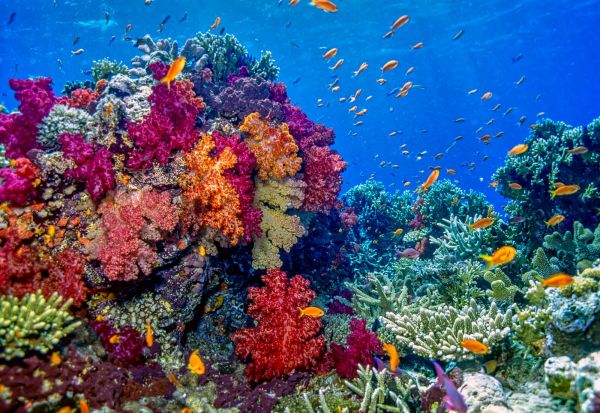

Every underwater photographer has the same heartbreaking moment: you review a shot on the boat deck, and the nudibranch you spent ten minutes stalking is lost in a snowstorm of white specks, lit from the wrong side, or washed in a flat blue-green haze. The camera was fine. The lighting was the problem. This guide walks through where your strobe should sit, how to aim it, and how to stop lighting the water instead of the subject.
- Why you need light: water filters colour and contrast quickly, and red goes first.
- Get close, then closer: a few feet of water is already enough to dull a photo.
- Place strobes above the lens, aimed forward: and match their spread to your shooting distance.
- Backscatter is a placement problem: light only the edge of the beam on the subject and keep the water in front of the lens dark.
- Review and adjust: push strobes wider after every speck-filled frame.
Why the water takes your colour away
Water absorbs light as you descend, and it does not absorb every colour equally. According to NOAA Ocean Exploration, blue light travels furthest, followed by green, yellow and orange, while red is filtered out fastest; by roughly 100 metres (about 328 feet) no red light is left at all. For a recreational diver at 10 to 30 metres, that means a red sponge or a coral wall looks muted and brownish in natural light, even though your eyes may partly compensate.
There is a second loss that has nothing to do with colour: contrast. Jim Decker of Backscatter, writing in Scuba Diving magazine, notes that contrast and colour begin to drop at about five feet (1.5 metres) between camera and subject, even in good visibility. A strobe (an underwater flash) solves both problems at once, because it adds back the full colour spectrum from a short distance. That is why the single most useful rule in underwater photography is also the simplest: shorten the water between the lens and what you are shooting.
If you want the broader picture of ambient light, sun angles and wide-angle exposure, our earlier piece Understanding Light in Underwater Photography covers that ground. This article focuses on artificial light and where to put it.
Strobe or video light: which one to use for stills
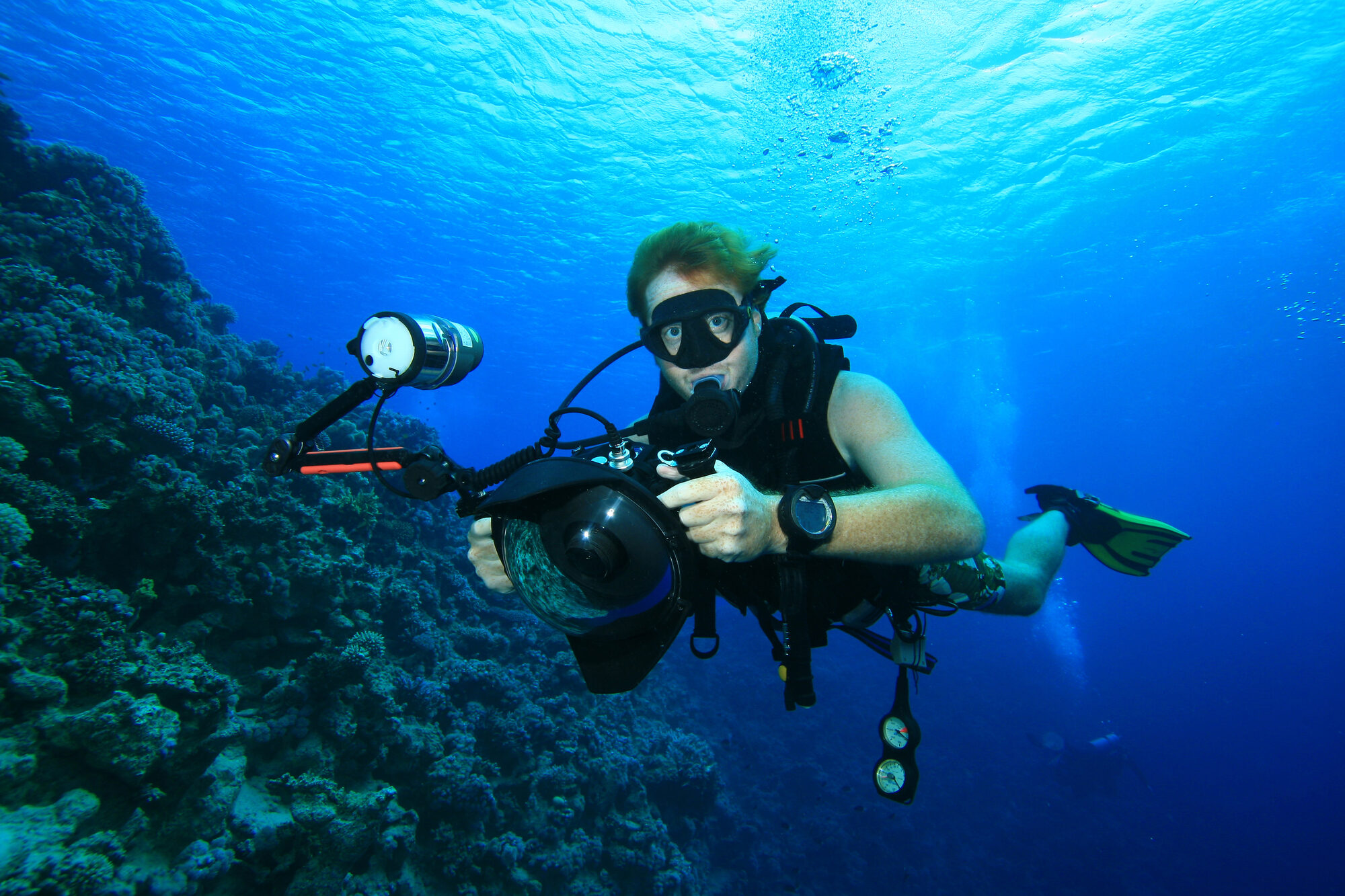
Continuous video lights are easy to use because you see the result instantly, and they are fine for very casual shots and for filming. For stills, a strobe is usually the better tool: it delivers a brief, powerful burst that freezes motion, overpowers the ambient light so colours pop, and lets you use a fast shutter speed. The trade-off is that you are working a little blind, since you cannot see the exact lighting until the shutter fires. That is why placement habits matter so much, and why reviewing your images between shots is part of the technique.
The core rules of strobe placement
Most experienced shooters agree on a handful of principles. These come from Decker’s guidance in Scuba Diving and on Backscatter.com, and from the Underwater Photography Guide.
- Aim at what you want to light. Choose the foreground subject first, then point the strobes at it. Strobes cannot light an entire scene, so do not expect them to.
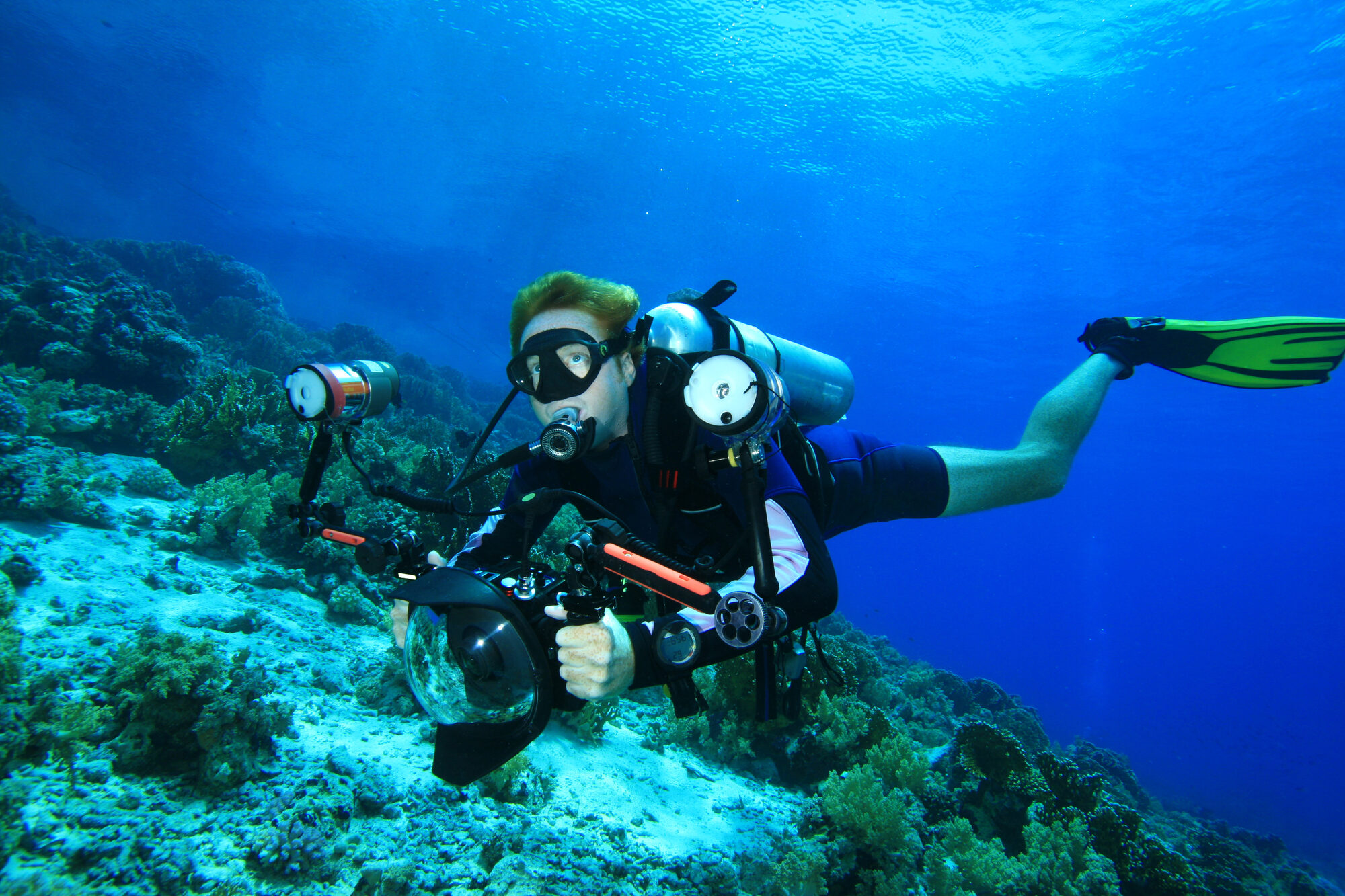
- Keep strobes above the lens centreline. Decker’s advice is to keep strobes above the level of the lens so shadows fall naturally, as they would under sunlight, and the lighting does not look spooky.
- Point them forward, not inward. Crossing the beams in front of the camera lights the water in the middle of your frame.
- Scale the spread to distance. Pull strobes tight to the housing for very close subjects, and move them wider as the subject gets farther away.
- Do not aim them straight at the subject. An older Scuba.com tutorial puts it bluntly: never point strobes directly at the subject, because it also lights the water in front of and behind it.

Wide-angle lighting: a worked example
Say you are photographing a gorgonian fan with a fisheye lens. Backscatter’s Decker typically works 6 inches to 2 feet (15 to 60 cm) from the subject, with about 3 feet (90 cm) as a maximum. At that distance, here is a sensible routine:
- Set your strobes on arms with the heads above the lens line and behind the housing handles. If they sit too far forward, a glow can creep into the corners of the frame.
- Start with the strobes fairly wide. A useful starting rule from Decker: the distance from strobe to housing should be roughly equal to the distance from lens to subject. This leaves a dark, unlit zone of water in front of the lens.
- Take a test shot and check the screen for white specks.
- If you see specks, push the strobes wider still, and re-aim so only the edge of each beam reaches the fan.
- If one strobe is much closer to the subject than the other, turn it down. Decker’s advice is to reduce power on the nearer light to avoid overexposure.
Running both strobes at identical power can flatten the image. Our earlier guide to underwater light makes the same point: strobe angle, power and distance are the tools for adding dimension.
Macro lighting: close and forward
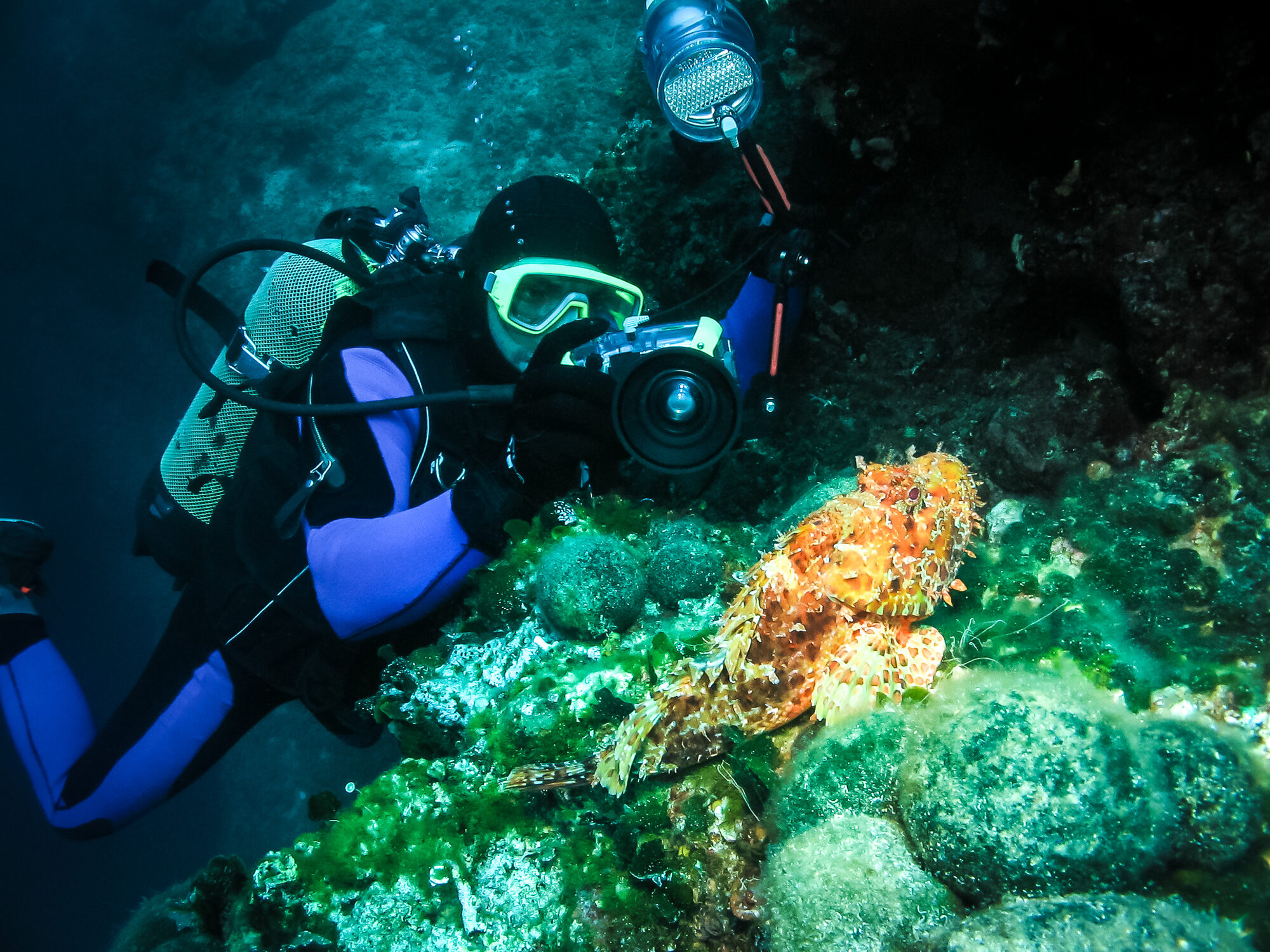
Macro is more forgiving, because the subject is small and the beam is wide. Decker notes that macro strobe beams are about 90 degrees or wider, so exact aim matters less. A one-strobe setup works for many subjects, and a second strobe softens the shadows cast by the first. For a single light, mount it on top. For two, put one on top and one at the side, which keeps both usable when you rotate the camera to shoot vertically.
For tiny, very close subjects, move the strobes in just far enough that the edges of the beam cones touch the subject, while angling them slightly outward. New to close-up work? Start with our Introduction to Macro Photography.
Beating backscatter
Backscatter is the white spotting that appears when strobe light bounces off particles floating between the lens and the subject. The Adorama Learning Center explains it simply: light from your strobe hits a particle and reflects back into your lens. Here are the fixes that work, roughly in order of impact.
- Get closer. Less water between subject and lens means fewer particles to light.
- Use the edge of the beam. Scott Gietler of the Underwater Photography Guide recommends lighting the subject with only the edge of each beam. For a fish two to three feet away, mount strobes wide and angle them slightly outward.
- Light from above. Moving a strobe to the top and lighting downward means the lens sees mostly shadowed water. This works well over sand but less well with translucent subjects.
- Shoot against the reef. Open water behind the subject, lit by the strobe, shows up as speckle against dark backgrounds.
- Do not stir the bottom. Gietler suggests frog kicks rather than flutter kicks, and a pointer stick in current. Keep buddies a few feet away, downcurrent of the subject.
Backscatter can be reduced, but rarely eliminated, particularly in low visibility. In murky water, switch to close-focus wide-angle shots with the strobes tucked in.
| Problem in your photo | Likely cause | Fix |
|---|---|---|
| White specks across the frame | Beams overlap in front of the lens | Push strobes wider, use beam edges, move closer |
| Dark hole in the middle of a wide shot | Strobes too wide for a close subject | Pull strobes in toward the housing |
| One side blown out, one side dark | Uneven distance or power | Turn down the closer strobe, turn up the farther one |
| Glow in the frame corners | Strobes sit too far forward | Keep heads behind the housing handles |
| Spooky, upward shadows | Strobes below the lens | Raise them above the lens centreline |
Power, recycle time and what to look for in a strobe
Strobe makers rate output with a guide number, but treat it with caution: the Scuba.com tutorial points out that the quoted range may be measured above water, so underwater you need to be closer than the number suggests. For recycle time, around one second is considered very good and three to four seconds slow, which matters when a shy subject will not wait. The same source recommends rechargeable batteries with enough capacity for roughly 100 to 300 shots per dive. These figures come from an older article, so check your own manufacturer’s manual for current specifications.
If you shoot a compact camera, you are not locked out. Gietler suggests using the camera’s diffuser to soften the internal flash a little, or better, adding an external strobe and blocking the internal flash. Our guide to underwater photography with a compact camera shows how to get started, and Know Your Settings explains how shutter speed and aperture work with your strobes.
On a calm shallow dive, pick one coral head or sponge. Shoot it five times from the same distance, moving the strobes a little wider each time. Back on the boat, compare the frames and note which strobe position gave you colour without specks. Do the same on your next dive at a different distance. Within two or three dives you will have a feel for your own gear that no article can give you.
Common mistakes and how to fix them
- Chasing the subject. Settle your buoyancy first. A drifting photographer kicks up silt. Hover, then compose.
- Shooting from too far away. If you are beyond about 3 feet (90 cm) with a wide lens, swap for a closer composition.
- Never reviewing. A quick look at the screen after each shot tells you more than any rule.
- Over-correcting in editing. Heavily boosting red in software can make a reef look artificial. Good strobe work means less rescue later.
- Forgetting marine life. Keep fins and gauges off the reef, and respect distance from animals. The shot is never worth the damage.
Frequently asked questions
Do I need two strobes?
Not to start. One strobe works well for macro, and a second helps with shadow control. For wide-angle, a pair is recommended by Decker for coverage and shadow control.
Why are my photos blue even with a strobe?
The strobe only reaches a short distance. Subjects beyond a few feet get little of its light, so they stay blue. Move closer or shoot a smaller scene.
Can I fix backscatter in editing?
Software can clone out some specks, but it is slow and rarely perfect. Prevention through placement is far quicker.
Should I use the strobe aiming lights?
Gietler advises using them sparingly, mainly for supermacro, very clear water or caves, since extra light can disturb animals.
Sources: NOAA Ocean Exploration, “red color”; Jim Decker, “How To Position Strobes,” Scuba Diving (2016); Jim Decker, “The Zen of Underwater Strobe Placement,” Backscatter.com; Scott Gietler, “Backscatter in underwater photography,” Underwater Photography Guide; Westmorland and Weiss, Adorama Learning Center (2012); Scuba.com, “The Importance of Strobe Lighting” (2010).