Maybe you’ve always wanted to try freediving. Or maybe you have no idea what the term really even means. Either way, this post is for you.
What is freediving?
Basically, freediving is breath holding. Type the term into Google and you receive a relatively broad spectrum of searches and free-diving associations from around the world, most of which discuss the technicalities of the sport, and how to try it for yourself.
They key to freediving is a word in the name itself: free. True champions of the discipline and lovers of the sport all claim the same — when you are beneath the sea with nothing but the suit on your back and the simple anatomic reactions enacted by the act of ignoring your breath, the encompassing ease and resulting relaxation is akin to a meditative state, and one of the most marvelous feelings in the world.
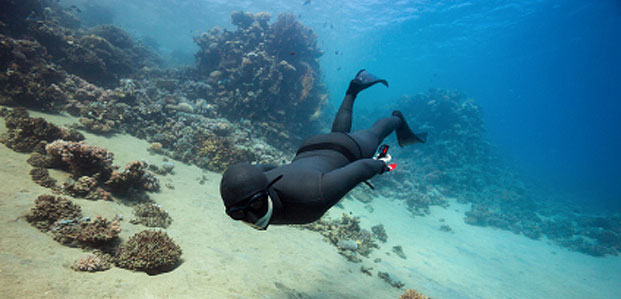
Even if extended breath-holding isn’t for you, it’s still a skill one can practice and improve. But due to the intricacies of individual physiology, it may not be the optimal sport for your system, so please take care should you want to try freediving for yourself.
Some important rules:
- Do not begin freediving by yourself. Take a buddy into the pool or shallow spot in the ocean and do not leave eachother alone during your practice sessions. Some of the worlds best freedivers have succumbed to fatal accidents in no more than 10 feet of water because no one was watching out for them. Anyway, it’s more fun if you have support.
- You are not a fish. Nor will you suddenly be a fantastic freediver after your first attempt at a prolonged period beneath the surface. Altering your body’s natural impulses to breathe takes practice, and improves with time and training.
- Don’t freedive drunk, hung over or on any illicit drugs. Your body will react differently after use of these chemical alterations and it is possible that your natural limits will change without your awareness.
- Enjoy it. Freediving is about being free, not about being the big man (or woman) in the ocean. Relax and enjoy the sport — the only person you have to compete with, and indeed the only one you can control, is you.
How is it possible?
Enter the mammalian diving reflex. We’re animals right? Despite the fact we’ve deluded ourselves into thinking our species is super-evolved, we still operate on basic instincts, one of which is called the “mammalian diving reflex.” This reaction occurs the moment our faces are placed in tepid water: the heart rate slows down (also known as bradycardia) and blood vessels constrict in less essential parts of the body in order to reroute its energy to the vital organs, namely the brain and the heart. We actually weren’t aware that humans were capable of the MDR until trials in the 1950s, although scientists began to understand and document it in animals in the early 1900s.
Apnea also allows us to hold our breath for an extended period of time. It’s defined as the temporary cessation or absence of breathing. When you hold your breath AND stick your head into the water, the MDR kicks into overdrive; when you remove your face from the water and breath again, the reflex stops.
Freediving uses both the mammalian diving reflex and apnea, as well as special finning techniques, unique weighting and mental discipline to achieve ever-increasing depth without utilizing breathing equipment.
History of Freediving
Freediving has been around for a very long time; early civilizations would surely have held their breath to fish for supper or explore the underwater world as much as possible. Long thought to be mere legend, the first known free-diver was Chatzistathis, a 35-year-old Greek sailor who managed to retrieve an anchor from a sunken ship at 289 feet (88 m) below sea level with only the air in his lungs. The dive is said to have lasted three minutes and occurred in 1913.
After WWII, the sub-surface sport gained popularity throughout the world. Enzio Maiorca blasted past 164 feet (50 m) in 1962 to the amazement of scientists who were convinced the pressure exerted by that much water would collapse the human lungs. Jacques Mayol took the sport in a new direction, using yoga techniques and meditation to calm his body rather than the previously practiced hyperventilation, and plunged to 328 feet (100 m).
One of the most interesting aspects of freediving is that it seems to chose its players, rather than the other way around. Some people are born with the ability, and freediving makes no distinction or segregation by age, gender, or nationality. In fact, Italian Angela Bandini astounded the aquatic community by being the first person (not just woman) to reach 351 feet (107 m) in 1989.
The 1980s and 90s saw the growth and development of an international freediving community and November 2, 1992 the Association Internationale pour le Développement de l’Apnée (or AIDA) was born.
Since the creation of AIDA and the explosion of easy, long-distance communication, there has been a tight, talented global network of freedivers, including those interested in competition, instruction and scientific exploration.
Types of competitive free-diving (as defined by AIDA)
Constant Weight Without Fins (CNF)
The diver follows an anchored rope, aiming to achieve the greatest depth possible and return to the surface with no propulsion equipment and without touching the rope.
Constant Weight (CWT)
The diver follows an anchored rope, aiming to achieve the greatest depth possible and return with the use of fins or a mono-fin. The diver may hold onto the rope once to stop descending and turn around.
Dynamic Without Fins (DNF)
The diver aims to achieve the longest horizontal distance possible without the use of fins or other propulsion equipment.
Dynamic With FIns (DYN)
The diver aims to achieve the longest horizontal distance possible with the use of fins or a mono-fin.
Static Apnea (STA)
The diver attempts to hold their breath for the longest possible time, either on or beneath the surface of the water, with both their mouth and nose submerged at a minimum.
Free Immersion (FIM)
The diver follows an anchored rope aiming to achieve the greatest depth possible and return to the surface with no propulsion equipment. The diver may use the rope to assist their descent and ascent.
VARIABLE WEIGHT (VWT)
The diver follows an anchored rope, using a weight or sled device to descend the greatest depth possible, and ascends using only their own strength either by swimming or by pulling themselves up with the rope.
No Limit (NLT)
The diver descends using weights to the greatest depth possible and ascends using whatever method they choose including balloons, inflatable vests and the like.
Freediving Gear
So what do you need to give it a try?
Mask Visit your local dive shop to find a mask that fits you properly. Without stretching the strap around your head, place the mask on your face and breathe in. If it stays in place by suction alone, you’re in good shape.
Snorkel Most masks do not come with a snorkel. Choose one that fits comfortably in your mouth without feeling the need to clench your jaw or stretch your lips.
Wetsuit Depending on your location, you may need a neoprene wetsuit (for colder water) or a full-body rash guard (for warmer water). If you live in the tropics, you can probably get away with Speedos and a lack of body hair, but what you are trying to achieve is the path of least resistance in the water so you can move quickly and efficiently through the sea. Although you may not be submerged for an extended amount of time like scuba divers, you do not want to get cold as shivering makes it much more difficult to relax and control your body underwater.
Fins Free-diving fins are lightweight and long, different from scuba fins. Select a pair that comfortably fit your feet and do not slip. They should feel like part of your anatomy.
Weights Humans are naturally buoyant (most humans) so you will need weights to pull you downward or to control your rate of ascent/decent. Visit your local dive shop or sign up on a diving forum for more beginner information
Now what?
According to Fabrizio Serra, Italian free-diving instructor at www.waterinstinct.it, start training yourself to slow your breath in a safe place where you feel relaxed, such as your bed. Take long, deep breaths and then, when you feel your entire body is calm and no part of you is tense, take a breath in and hold it as you click a timer. When you feel the first need-to-breathe contraction, suppress it by splitting your focus — conjugate verbs; count backwards from 100; trace shapes on the wall with your eyes. Eventually, the need to breath will get the better of you and that’s ok. Stop the timer and give yourself a pat on the back, you’re on your way to becoming a freediver.
Once you feel ready, grab your kit and your companion and hit the pool. Train yourself to hold your breath while floating face down at the surface first, then gradually build up to doing the same while weighted at the bottom of the pool. After you’re getting good at that, try diving down in open water — again, with a buddy.
Keep it up; train your body and your mind; enjoy the experience with your buddy; and share it with free-diving devotees around the world online.
Resources
