One of the biggest problem skills I’ve seen as an instructor is breathing without a mask underwater. Some people handle it fine, but others have extreme, nearly insurmountable difficulty with it. After a couple of difficult sessions with some student divers, I decided to try to learn how to teach the skill better. I needed a better way to impart knowledge instead of just saying, “Just don’t let the water in!” without really knowing how to tell them not to let the water in. I really didn’t understand why or how I was keeping the water out myself. I just did it! I always have. I was never a nose-holder.
After some research, I thought I’d share here. I realize there are a lot of experienced divers here, but that doesn’t mean that readers haven’t had an issue when it comes to breathing without a mask underwater. And, I’m sure we also have some newer divers reading who perhaps barely made it through that skill in the hopes that they would never, ever have to do it again. I’m sorry to say to those individuals… you probably will have to deal with it again. Masks flood, they get knocked off. It happens and you should be prepared for it and be confident that you’ll be okay with it.
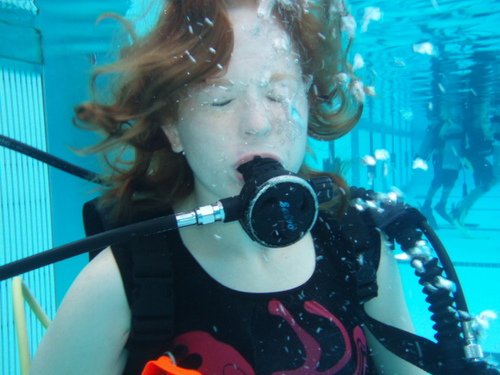
While I’m sure you’ve noticed people jumping in while holding their noses, have you noticed all the people not doing it? What do they know that you don’t? Some double top secret dolphin technique? Nah,they just know how to control their body to keep the water from entering too far into their nose. There’s no way to prevent water from getting into your nose proper, but you can stop it from ending up down your throat and choking you. (But if you do know a double top secret dolphin technique, please let me know!)
There are a couple of things that help you keep from inhaling water through your nose in the situation we’re talking about: Soft palate control and Epiglottis control. The two things work in tandem, so it can be difficult to distinguish which is which. I’m hoping the exercises below will help with that.
Exercises:
Testing soft palate control
Put on your mask without the strap around your head and suck in through your nose to try to keep the mask on. If your mask fits correctly, this shouldn’t be a problem. (This is how most folks “try on” masks before buying them anyway) While you’ve got the mask ‘stuck’ to your face, start breathing normally through your mouth and keep the mask on your face. Tilt your head down a bit so that you know the mask isn’t just balancing on your face.
If you can do this for a bit, then you have what it takes to breath without a mask on; you have soft palate control. You just need to get over the psychological aspect of breathing with water on your nose.
If the mask immediately drops off of your face, then you don’t have very good soft palate control at all and you should learn and practice it.
Epiglottis and soft palate control
Now a new test. While exhaling through your mouth, cover your mouth with your hand to prevent air from escaping. Did your cheeks puff up? They should have! And, you should not be exhaling through your nose. That’s soft palate control.
While still trying to exhale, move your hand away. If you immediately exhale through your mouth, you used soft palate control. If you paused before exhaling through your mouth, that was your epiglottis. Either is okay, we’re just trying to get you to understand your own body at this point and how things work and feel.
Now we’re going to try alternating a bit. Take a breath, exhale through your mouth, then cover your mouth and switch to exhale through your nose. Did you feel a little nudge or jolt above and at the back of your tongue? That was your soft palate opening to let the air out of your nose.
Maybe you felt a little jolt closer to your lower neck or chest. If so, that’s your epiglottis.
Alternate now between exhaling through your nose and trying to exhale through your covered mouth. Do you feel that control? Remember it. That’s how you keep water out too!
Practice makes perfect if you’re having difficulty with this. I don’t think I can stress enough how important it is as a diver to be comfortable with water on your nose. Comfortable to the point that you’re not going to panic and bolt to the surface, at least. Practice in a tub, pool, hot tub, even the shower. (you could flood your mask in the shower, stand with it flooded and just breathe through your mouth) Practice it a little every time you dive until you are comfortable with it. It will make you a more confident diver and a safer diver.
For some more exercises on getting more control of your soft palate and learning how to equalize without using your hands, check out this document:
http://folk.uio.no/gardot/frenzel.pdf
Has anyone had issues with breathing without the mask on underwater? How did you overcome them?
